
F-gas Regulation 2027: heat pump and AC bans

9 min read
F-gas Regulation and heat pumps: which monoblock and split units are banned from 1 January 2027, what follows to 2035, and what importers must do first.
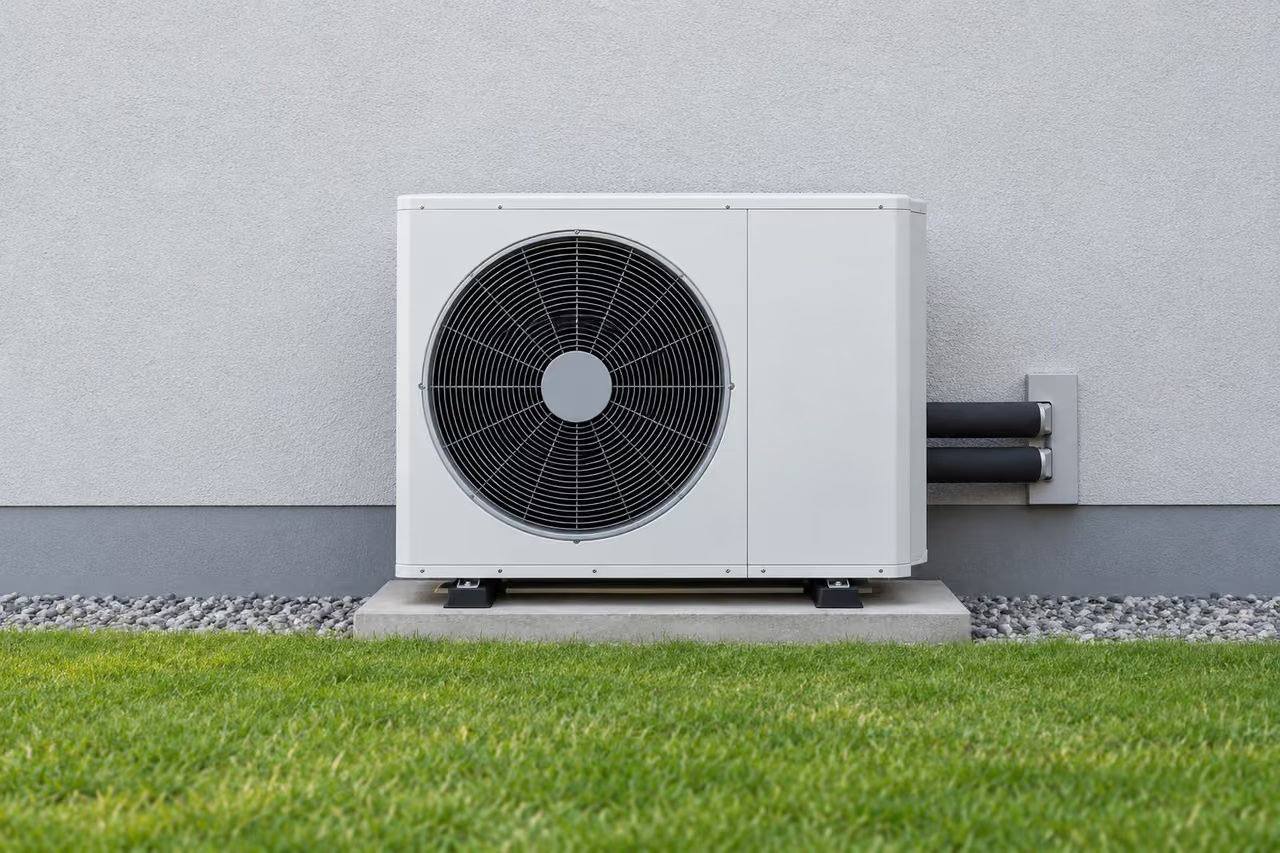
You build heat pumps or air conditioners in Asia or the U.S. and sell them in the EU. From 1 January 2027, the F-gas Regulation (EU) 2024/573 bans placing many of them on the EU market with refrigerants of a global warming potential of 150 or more, such as R-32. Here is what is banned when, up to 2035, and which import duties apply in any case.
F-gas Regulation and heat pumps: what changes on 1 January 2027
Regulation (EU) 2024/573 (opens in a new tab) applies directly in every member state (Article 38). Its Annex IV lists products that may not be placed on the market from a set date (Article 11(1)); for an imported unit, that is the customs release for free circulation (Article 3(6)), not the factory dispatch.
- R-32 (HFC-32): GWP 675 (Annex I), above 150 and below 750.
- R-410A: GWP 2,088 according to Germany's Environment Agency (UBA).
- HFOs such as HFC-1234yf (GWP 0.501) and HFC-1234ze (GWP 1.37): Annex II F-gases below 150, but caught by the 2032 and 2035 bans for units up to 12 kW.
- Propane (R-290) is not an F-gas: it is not listed in Annexes I to III, so the Annex IV bans do not apply to it.
Monoblock or split: which category your unit falls into
A self-contained system is complete from the factory, with no gas-containing parts connected on site (Article 3(38)); a typical air-to-water monoblock fits this. A split system needs refrigerant components connected at the point of use (Article 3(39)); fixed double duct units count as split (footnote to Annex IV).
The Regulation does not define rated capacity. UBA reads it as the capacity the manufacturer declares under standard rating conditions, for heat pump space heaters the rated heat output under Regulation (EU) No 813/2013. Units whose primary function is to cool a heat transfer fluid are chillers with their own dates (Article 3(44); Annex IV, point 7).
Placing on the market bans from 2027 to 2035
Annex IV sets these dates:
| Equipment (Annex IV point) | Rated capacity | Banned from | F-gases affected |
|---|---|---|---|
| Single split with less than 3 kg of Annex I gases (9(a)) | Any | 1 January 2025 | GWP 750 or more |
| Self-contained, such as monoblock or plug-in (8(b)) | Up to 12 kW | 1 January 2027 | GWP 150 or more (safety exception: up to 750) |
| Self-contained (8(d)) | Over 12 kW to 50 kW | 1 January 2027 | GWP 150 or more (safety exception: up to 750) |
| Split air-to-water (9(b)) | Up to 12 kW | 1 January 2027 | GWP 150 or more (safety exception) |
| Split air-to-air (9(c)) | Up to 12 kW | 1 January 2029 | GWP 150 or more (safety exception) |
| Split (9(e)) | Over 12 kW | 1 January 2029 | GWP 750 or more (safety exception) |
| Other self-contained (8(e)) | Not in 8(b) or 8(d), in practice over 50 kW | 1 January 2030 | GWP 150 or more (safety exception: up to 750) |
| Self-contained (8(c)) | Up to 12 kW | 1 January 2032 | All F-gases (safety exception: up to 750) |
| Split (9(f)) | Over 12 kW | 1 January 2033 | GWP 150 or more (safety exception) |
| Split (9(d)) | Up to 12 kW | 1 January 2035 | All F-gases (safety exception) |
The safety exception is narrow. It needs safety requirements at the site of operation, from EU or national law or standards that must be applied there, that rule out the lower-GWP option (Article 3(42)); an operator's own rules do not count (UBA). Such units must be labeled “Prohibited to be operated, unless required by safety requirements that have to be applied at the site of operation” with the applicable requirement added (Article 1(12) of Implementing Regulation (EU) 2024/2174). The operator must prove the requirement before operation and keep the evidence for at least 5 years (Article 13(19)(a) and (20)).
Stock, spare parts and units in transit
- Stock placed on the market in time may still be sold. From 1 January 2028, sellers must prove the lawful placing before the 2027 ban (Article 11(1)); operators need the same proof to put a unit into operation (Article 13(19)(b)).
- Spare parts remain allowed if the repair raises neither the capacity, the amount of F-gas nor the GWP (Article 11(1)). According to UBA, an outdoor or indoor unit is not a spare part.
Duties for imported units with F-gases
These duties apply whatever the Annex IV status; points 3 to 5 only from 10 tonnes of CO2 equivalent of HFCs a year, about 14.8 kg of R-32 (Articles 19(6) and 26(4)):
- Label with “Contains fluorinated greenhouse gases”, the industry designation, the quantity in kg and tonnes of CO2 equivalent, and the GWP; next to the service ports or on the gas-containing part, in the official languages of the member state where it is sold (Article 12(3) and (4); Implementing Regulation (EU) 2024/2174). Manuals and, from GWP 150, advertising repeat the data (Article 12(16)).
- Portal registration: the importer's registration in the F-gas Portal is its import license (Articles 20(4), 20(5) and 22(1)).
- Quota authorizations for HFCs, including blends with an HFC (Article 3(4)), usually from a quota holder in the F-gas Portal, for the full quantity before customs release (Articles 19(1), 21(2) and 23(4)).
- F-gas declaration of conformity on the template in Implementing Regulation (EU) 2025/2155, kept for at least 5 years and available to customs at release (Articles 19(2) and 23(8)).
- Report and audit: a report by 31 March (Article 26(4); yearly according to the Commission) and, where the HFCs were not on the EU market before charging, an independent auditor's check by 30 April each year (Article 19(3)).
- Installer evidence: non-hermetically sealed units charged with F-gases may only be sold to end users with evidence that a certified company will install them (Article 11(7)).
Registration, authorizations and the declaration sit with the importer named in the customs declaration (Articles 19(2) and 23(2)). An importer of such HFC units without an EU establishment must appoint an F-gas only representative in the EU that assumes full responsibility for compliance (Article 19(5)).
Practical example: a heat pump maker from Asia with three R-32 lines
An Asian manufacturer sells three R-32 lines through an EU distributor as importer.
| Product line | Annex IV point | Status from 1 January 2027 | Next step |
|---|---|---|---|
| 9 kW air-to-water monoblock | 8(b) | Banned, except where site safety requires it | Switch below GWP 150 (propane also avoids the 2032 ban); release R-32 stock by 31 December 2026 |
| 8 kW air-to-water split | 9(b) | Banned, same exception | Redesign below GWP 150; F-gases end for this size on 1 January 2035 |
| 3.5 kW air-to-air split air conditioner | 9(c) | Allowed until 31 December 2028 | Keep documents current; switch before 2029 |
With 1.0 kg of R-32, each air conditioner holds 0.675 tonnes of CO2 equivalent (Article 3(3)); 2,000 units need authorizations for 1,350 tonnes before import.
Common mistakes with the 2027 heat pump rules
- Expecting the Authorized Representative to cover F-gas duties. They sit with the importer or its only representative.
- Mixing up two declarations. The F-gas declaration under Article 19(2) is not the CE Declaration of Conformity.
Conclusion: sort every model by design, capacity and refrigerant
Check each model against the table and plan the last customs releases of banned models before 1 January 2027. Member states set the penalties; for unlawful imports, the maximum administrative fine must be at least five times the market value of the goods (Article 31(4)).
Heat pumps also fall under CE legislation listed in Article 4(5) of Regulation (EU) 2019/1020 (opens in a new tab), such as the EMC Directive 2014/30/EU, so an EU economic operator must be named on the product, its packaging, the parcel or an accompanying document (Article 4(4)). Our renewable energy page shows the typical acts; see also Authorized Representative or importer.
Representa's compliance consulting builds a roadmap for your models against the Annex IV dates, reviews your documentation and prioritizes fixes. As your EU Authorized Representative for the CE side, we act within the agreed scope and mandate; you remain the manufacturer.
Frequently asked questions
Can I still sell R-32 heat pumps in the EU after 1 January 2027?
It depends on the design. With R-32 (GWP 675), self-contained units up to 50 kW and split air-to-water units up to 12 kW may not be placed on the market from that date unless site safety requires it (Annex IV, points 8(b), 8(d), 9(b)). Split air-to-air units up to 12 kW remain allowed until 31 December 2028. Units placed earlier may still be sold, from 2028 with proof (Article 11(1)).
Are propane (R-290) heat pumps affected by the F-gas Regulation?
Not by its bans, labels or quota. Propane is not listed in Annexes I to III of Regulation (EU) 2024/573, so it is not a fluorinated greenhouse gas; Annex VI uses its GWP of 0.02 only to calculate blends. Other EU product rules, such as CE marking, still apply.
What does the F-gas label on a heat pump have to show?
The text “contains fluorinated greenhouse gases”, the industry designation of the gas, the quantity in kg and in tonnes of CO2 equivalent and the GWP, plus a note where the unit is hermetically sealed. It must be legible, indelible, next to the service ports or on the gas-containing part, and in the official languages of the member state (Article 12; Implementing Regulation (EU) 2024/2174).
Who needs an only representative under the F-gas Regulation?
An importer of refrigeration, air-conditioning or heat pump equipment pre-charged with HFCs that has no establishment in the EU, from 10 tonnes of CO2 equivalent a year (Article 19(6)). The only representative must be established in the EU and assumes full responsibility for compliance with the Regulation (Article 19(5)). It is not the Authorized Representative under CE legislation.
Do I need quota to ship pre-charged heat pumps to the EU?
From 10 tonnes of CO2 equivalent a year, about 14.8 kg of R-32 (Article 19(6)), your importer needs the HFCs in the units covered by the quota system (Article 19(1)), usually through authorizations from a quota holder in the F-gas Portal for the full quantity. According to the Commission, quota itself cannot be used for imported equipment.


