Partly completed machinery: what to supply

9 min read
Partly completed machinery in the EU: when robots and drive units qualify, what the declaration of incorporation must contain and what changes in 2027.
You build robot arms in Japan, drive units in Taiwan or packaging line modules in the U.S., and an EU integrator turns them into complete machines. Your product is then often partly completed machinery: it ships with a declaration of incorporation and assembly instructions instead of CE marking under the machinery rules. Here is what qualifies, what to supply, what your integrator does and what changes from 20 January 2027.
What counts as partly completed machinery
Until 19 January 2027, Article 2(g) of the Machinery Directive 2006/42/EC defines partly completed machinery as an assembly which is almost machinery but cannot in itself perform a specific application and is only intended for incorporation into other machinery. Article 3(10) of the Machinery Regulation (EU) 2023/1230 keeps that test. Typical cases, also on our industrial automation and machinery pages:
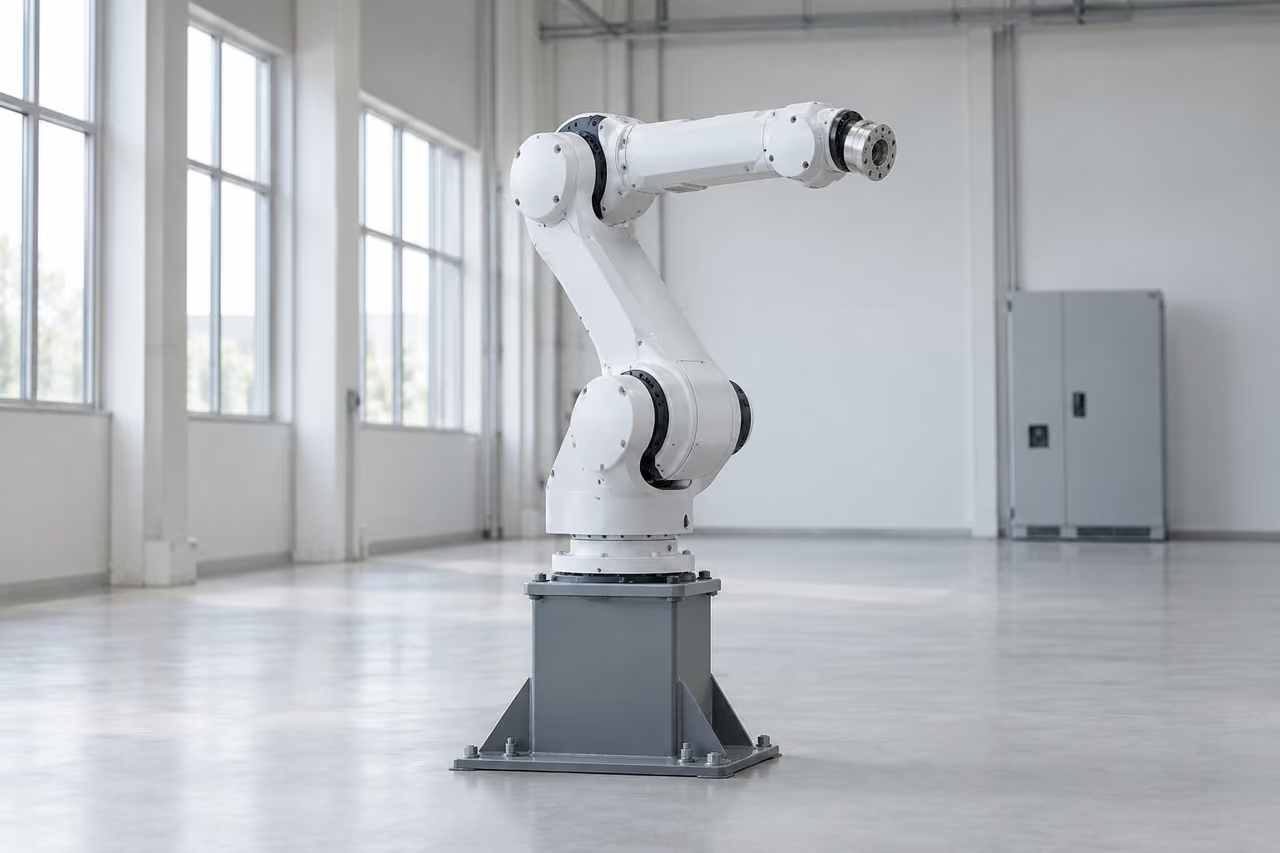
- Robots. Industrial robots are usually designed without a specific application; only one with end-effector and control system that can perform a specific application by itself is complete machinery (Commission guide to the Machinery Directive, section 46).
- Drive systems. The Directive names them (Article 2(g)); the guide means systems ready to be fitted, not general-purpose electric motors (section 46). The Regulation drops that sentence; from 20 January 2027 the general test decides.
- Line modules that can perform their application alone are complete machinery with CE marking, even inside a line (guide, section 38).
- Components such as ball bearings or solenoid valves are not covered as such (guide, section 46).
The declaration of incorporation and what ships with each unit
Article 13(1) of the Directive requires three documents before you place a unit on the market: relevant technical documentation (Annex VII, Part B), assembly instructions (Annex VI) and a declaration of incorporation (Annex II, 1.B). Declaration and instructions accompany the unit until it is incorporated and then join the technical file of the final machine (Article 13(2)).
Contents (Annex II, 1.B):
- name and address of the manufacturer and, where appropriate, the Authorized Representative;
- the person authorized to compile the relevant technical documentation, established in the EU;
- description and identification, such as function, model, type and serial number;
- which essential requirements are applied and fulfilled, plus conformity with other directives where relevant;
- an undertaking to send authorities relevant information on a reasoned request;
- a statement that it must not be put into service before the final machine is declared in conformity;
- place, date and signature.
The assembly instructions set out the conditions for safe incorporation, in an EU language the integrator accepts (Annex VI), and flag requirements left to the integrator (guide, sections 385 and 390).
The technical documentation must be available to authorities for at least 10 years after the last unit is manufactured; it may stay outside the EU, but the person named in the declaration must be able to present it (Annex VII, Part B).
Why there is no CE marking and no notified body
Under the machinery rules, CE marking belongs to complete machinery and related products (Articles 5(1)(f) and 16 of the Directive; Articles 3(25) and 24 of the Regulation); Article 30(2) of Regulation (EC) No 765/2008 permits it only where legislation provides for it. The Commission's guide states that partly completed machinery must not bear it (section 106). Other acts, such as the Radio Equipment Directive or ATEX, can still require their CE marking (guide, section 38).
Conformity assessment procedures, including those with a notified body, likewise apply only to machinery and related products (Article 12 of the Directive; Articles 6(1) and 25 of the Regulation). If the final machine falls under Annex IV of the Directive or Annex I of the Regulation, the integrator applies the procedure for that category to the whole machine.
What your EU integrator does with your unit
The final machine is machinery in its own right, and whoever builds it becomes its manufacturer (guide, sections 38 and 46). The integrator:
- should check your declaration and instructions before buying (guide, section 46);
- assesses the risks of the whole machine, including interfaces and requirements left open (guide, section 38; Annex III, Part B, point 1 of the Regulation);
- runs the conformity assessment;
- files your declaration and instructions in its technical file (Annex VII, Part A of the Directive; Annex IV, Part A, point (j) of the Regulation);
- issues the Declaration of Conformity and affixes the CE marking.
If your unit's control system delivers safety functions, give the integrator its safety performance and reliability data in the assembly instructions (guide, section 46).
Who must be in the EU for partly completed machinery
Article 4 of Regulation (EU) 2019/1020 (opens in a new tab) requires an economic operator established in the EU for products under the acts in Article 4(5), including Directive 2006/42/EC, which covers partly completed machinery (Article 1(1)(g)). From 20 January 2027, that reference is read as one to the Regulation (Article 51(2) and Recital 8 of the Regulation).
That operator is usually an EU importer or an Authorized Representative with a written mandate covering the tasks in Article 4(3); its name and contact details, including the postal address, go on the product, packaging, parcel or an accompanying document (Article 4(4)). If your integrator imports the units, it is the importer and, from 20 January 2027, adds its own details (Article 14(3) of the Regulation). See Authorized Representative or importer.
What changes on 20 January 2027
The Regulation applies from 20 January 2027 (Article 54, corrected in OJ L 169). Units placed on the market in conformity with the Directive before then may still be made available (Article 52(1)); units placed later must meet the Regulation (see our Machinery Regulation checklist).
| Topic | Directive 2006/42/EC | Regulation (EU) 2023/1230 |
|---|---|---|
| Definition | Almost machinery; drive systems named expressly (Art. 2(g)) | Same test, drive sentence removed (Art. 3(10)) |
| Requirements | Declare those applied and fulfilled (Annex II, 1.B) | Meet the relevant Annex III requirements, except those only possible at incorporation (Art. 8, 11(1); Annex III, 1.1.1) |
| Declaration | Names an EU person for the documentation (Annex II, 1.B) | Names manufacturer and any representative; link or code allowed (Annex V, Part B; Art. 11(8)) |
| Marking | Identification in the declaration (Annex II, 1.B) | Designation, year, model, any serial number, name, postal address, digital contact (Art. 11(5), (6)) |
| Assembly instructions | EU language the integrator accepts (Annex VI) | Language set by the Member State; digital allowed, free paper copy on request at purchase (Art. 11(7)) |
| Retention | At least 10 years from last manufacture (Annex II, 2; Annex VII, B) | At least 10 years after placing on the market (Art. 11(3)) |
| Authorized Representative | May carry out the Article 13 procedure (Art. 5(2)) | Mandate excludes design, construction and the technical documentation (Art. 12(1)) |
Practical example: a Japanese robot maker
A Japanese maker without an EU subsidiary supplies a German integrator:
| Product | Classification | What ships with it |
|---|---|---|
| Six-axis arm with controller, no gripper | Partly completed machinery | Declaration of incorporation, assembly instructions |
| Same arm as a palletizing cell with gripper and guarding | Complete machinery | Declaration of Conformity, instructions, CE marking |
| Servo motor sold for many uses | Not partly completed (guide, section 46) | No declaration of incorporation; check other EU rules |
Common mistakes with partly completed machinery
- CE marking the unit under the machinery rules. The guide rules it out (section 106).
- Sending the technical documentation to customers. They need declaration and instructions; you owe the documentation only to authorities (guide, sections 393 and 394).
- A vague declaration. Name each requirement applied and fulfilled (guide, section 385).
- No one in the EU. Article 4 of Regulation (EU) 2019/1020 applies even if only integrators buy.
Conclusion: classify first, then document
Classify each product; if it is partly completed, make the declaration and assembly instructions precise and keep the documentation ready for authorities.
As your EU Authorized Representative, Representa GmbH acts within the agreed scope and mandate: we provide our name and address for packaging and your declaration, keep your technical documentation for 10 years and handle authority inquiries. Our CE marking service helps you identify the applicable rules and standards and review your documentation. Design, documentation and declaration remain your responsibility as manufacturer.
Frequently asked questions
Does partly completed machinery need CE marking?
Not under the machinery rules. Directive 2006/42/EC and Regulation (EU) 2023/1230 provide CE marking for complete machinery, not for partly completed machinery, which ships with a declaration of incorporation and assembly instructions. If another act such as the Radio Equipment Directive applies to the unit, it carries CE marking for that act.
Is an industrial robot partly completed machinery?
Usually yes. The Commission's guide to the Machinery Directive (section 46) explains that industrial robots are usually designed without a specific application. Only a robot supplied with an end-effector and control system, so that it can perform a specific application by itself, is complete machinery.
Does partly completed machinery need a notified body?
No. Conformity assessment procedures, including those with a notified body, apply to machinery and related products (Article 12 of Directive 2006/42/EC, Article 25 of Regulation (EU) 2023/1230). If the final machine falls under Annex IV of the Directive or Annex I of the Regulation, its manufacturer applies the procedure for that category to the whole machine.
Do I need an EU Authorized Representative for partly completed machinery?
You need an economic operator established in the EU. Article 4 of Regulation (EU) 2019/1020 applies to products under Directive 2006/42/EC, including partly completed machinery. If your EU customer imports the units, it can take that role as importer; otherwise an Authorized Representative with a written mandate.
Must I give my technical documentation to the integrator?
No. It must be available to national authorities on a reasoned request (Annex VII, Part B of the Directive; Article 11(3) and (10) of the Regulation). The Commission's guide adds that there is no obligation to share it with customers (sections 393 and 394). Your integrator relies on the declaration of incorporation and the assembly instructions.