Pressure Equipment Directive: CE marking guide

10 min read
Pressure Equipment Directive CE marking for non-EU makers: scope, PED categories I to IV, modules and notified bodies, documents and your EU contact.
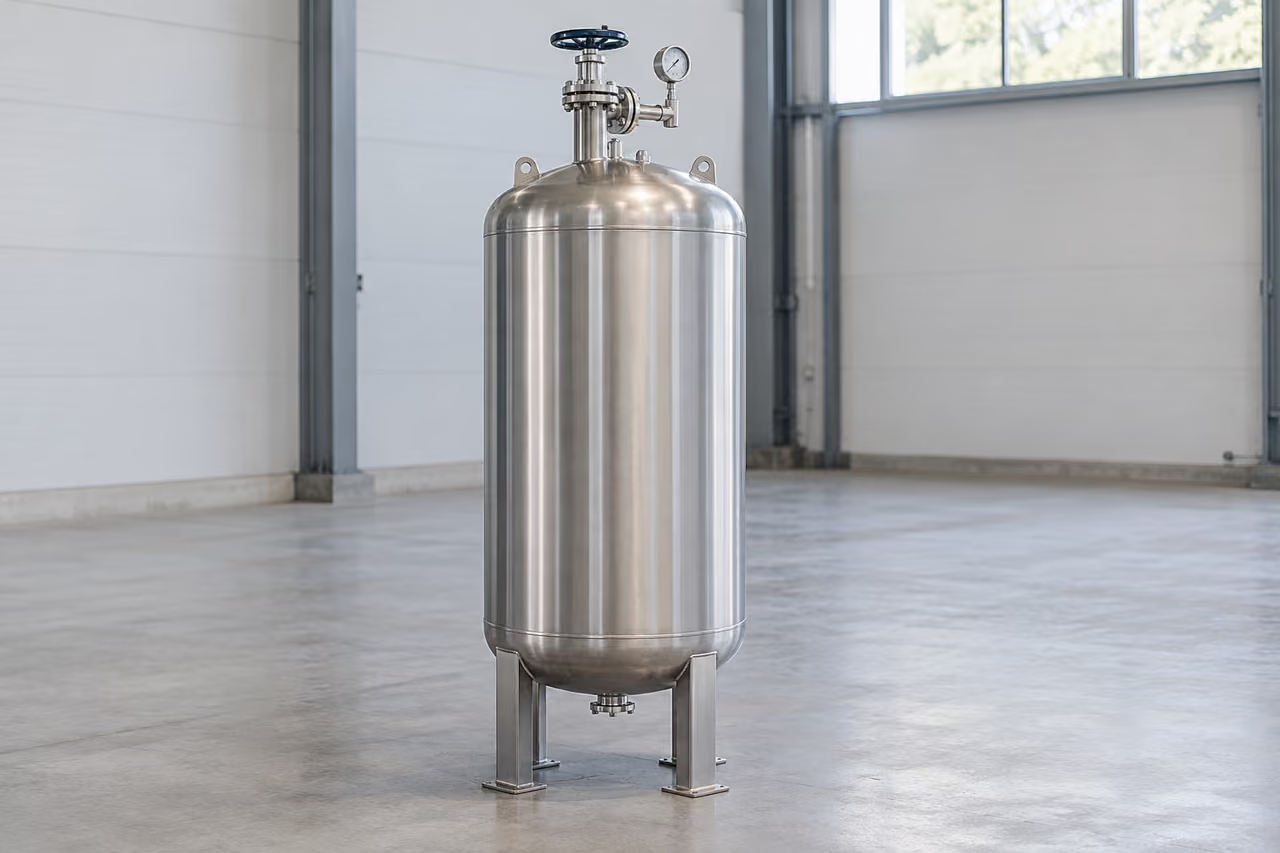
You build heat exchangers, vessels or valves in Asia, the U.S. or the UK, and an EU process plant wants to buy them. Three questions decide your effort: does the Pressure Equipment Directive 2014/68/EU (PED) apply, which category is the equipment in, and who in the EU answers for it? This guide to Pressure Equipment Directive CE marking answers all three, with a worked example.
What the Pressure Equipment Directive covers
Directive 2014/68/EU (opens in a new tab) applies to the design, manufacture and conformity assessment of pressure equipment and assemblies with a maximum allowable pressure PS greater than 0.5 bar (Article 1(1)). It has applied in full since 19 July 2016 (Articles 49 and 51) and works through national law in each member state.
Pressure equipment means vessels, piping, safety accessories such as safety valves, and pressure accessories such as valves (Article 2(1) to (5)). Pressure equipment you assemble into an integrated, functional whole forms an assembly, assessed as a whole (Articles 2(6) and 14(6)).
Under PED Guideline B-04 of the Commission's Working Group Pressure (not legally binding), heat exchangers count as vessels; only pipe coils that heat or cool air in refrigeration, air conditioning and heat pump systems can count as piping (Article 2(3)).
Exclusions: when the PED does not apply
Article 1(2) lists 21 exclusions. Three matter most for equipment makers:
- Simple pressure vessels under Directive 2014/29/EU (point (c)); see below.
- Equipment up to category I covered by the Machinery Directive 2006/42/EC or the lifts, low voltage, medical devices, gas appliances or ATEX legislation (point (f)). From 20 January 2027, read the Machinery Regulation (EU) 2023/1230 instead (its Article 51(2)).
- Casings and machinery where pressure is not a significant design factor, such as turbines, compressors and pumps (point (j)). This is decided case by case; over-dimensioning alone does not exclude equipment, and the exclusion does not apply to hermetic refrigeration compressors (PED Guidelines A-11 and A-12).
Machines with pressure parts, such as compressor packages, are covered on our industrial machinery page.
PED categories: classify each item in five steps
- Equipment type: vessel, piping, safety accessory or pressure accessory. Valves are normally classified by DN with the piping tables (Annex II, point 3; PED Guideline B-17); safety accessories are category IV, or may take the category of the specific equipment they are made to protect (Annex II, point 2).
- Gas or liquid: liquids whose vapor pressure at TS is more than 0.5 bar above atmospheric pressure use the gas tables (Article 4(1)).
- Fluid group (Article 13(1)): group 1 means fluids classified as hazardous under the EU's CLP Regulation on chemical classification in listed classes, such as explosives, flammable gases and liquids of categories 1 and 2, and oxidizing or acutely toxic substances of the listed categories, plus any fluid whose flashpoint is below TS. Air, nitrogen, water and steam are group 2.
- Annex II table: tables 1 to 4 for vessels by PS and V, table 5 for steam and hot-water generators, tables 6 to 9 for piping by PS and DN. A multi-chamber vessel takes the highest category of its chambers (Article 13(2)).
- Lower limits: at or below the values in the table, Article 4(3) applies: sound engineering practice of a member state and adequate instructions for use.
| Equipment and fluid | Group 1 | Group 2 |
|---|---|---|
| Vessels for gases | V over 1 and PS·V over 25 bar·L, or PS over 200 | V over 1 and PS·V over 50 bar·L, or PS over 1,000 |
| Vessels for liquids | V over 1 and PS·V over 200 bar·L, or PS over 500 | PS over 10 and PS·V over 10,000 bar·L, or PS over 1,000 |
| Piping for gases | DN over 25 | DN over 32 and PS·DN over 1,000 |
| Piping for liquids | DN over 25 and PS·DN over 2,000 | PS over 10, DN over 200 and PS·DN over 5,000 |
Modules: when you need a notified body
Article 14(2) fixes the modules per category; you may also use one listed for a higher category, such as unit verification (module G) for a one-off vessel (Article 14(3)). A notified body is an independent conformity assessment body notified by a member state; the Commission's NANDO database lists them.
| Category | Modules | Notified body |
|---|---|---|
| I | A (internal production control) | None |
| II | A2, D1 or E1 | Unannounced checks (A2) or quality system approval (D1, E1) |
| III | B (design type) with D or F, B (production type) with E or C2, or H | Design or type examination, then production checks; or full quality system (H) |
| IV | B (production type) with D or F, G or H1 | Type examination, then production checks; or unit verification (G); or full quality system with design examination (H1) |
Annex I adds approvals and certificates that the module names do not show:
- permanent joining (welding) procedures and personnel in categories II to IV, by a notified body or a recognized third-party organization (point 3.1.2);
- non-destructive testing personnel in categories III and IV, by a recognized third-party organization (point 3.1.3);
- material certificates of specific product control for main pressure-bearing parts from category II (point 4.3).
Where the notified body is involved in production control, its identification number follows the CE marking (Article 19(4)).
Technical file, marking and instructions
The technical documentation includes an adequate risk analysis and assessment and, where applicable (Annex III, module A, point 2):
- a description, drawings and explanations;
- the harmonized standards applied, or the solutions used instead (Article 12);
- design calculations, examinations and test reports, including the final proof test, normally hydrostatic; for vessels, as a rule at least 1.25 times the maximum in-service loading or 1.43 times PS, whichever is greater (Annex I, points 3.2.2 and 7.4);
- evidence that the materials meet their specifications (Annex I, points 4.2 and 4.3).
Keep it with the EU declaration of conformity for 10 years after placing on the market (Article 6(3)).
The equipment or a firmly attached dataplate carries the CE marking, your name and postal address (Article 6(6)), year of manufacture, identification and the essential allowable limits, plus data such as volume, test pressure and fluid group where relevant (Annex I, point 3.3).
Instructions cover mounting, putting into service, use and maintenance (point 3.4), in the language the member state determines (Article 6(7)); the declaration follows Annex IV and is translated as the member state requires (Article 17(2)).
Who must be in the EU for pressure equipment
Directives 2014/68/EU and 2014/29/EU are listed in Article 4(5) of Regulation (EU) 2019/1020 (opens in a new tab). Such equipment may only be placed on the market if an economic operator established in the EU is responsible for it (Article 4(1)): an EU manufacturer, the importer, an authorized representative with a written mandate or, as a last resort, a fulfillment service provider (Article 4(2)).
The operator's name and contact details, including the postal address, go on the product, packaging, parcel or an accompanying document (Article 4(4)); if customs find them missing, they suspend release (Article 26(1)(d)).
Under Article 7(1) of the PED, ensuring compliant design and manufacture and drawing up the technical documentation cannot be part of a representative's mandate; the mandate covers at least keeping the declaration and documentation for 10 years, supplying documents and cooperating with authorities (Article 7(2)). See also Authorized Representative or importer.
Simple pressure vessels: Directive 2014/29/EU
Compressed-air receivers often fall under Directive 2014/29/EU (opens in a new tab) instead: series-made, welded, unfired vessels for air or nitrogen, made of non-alloy quality steel or certain aluminum grades, shaped as a cylinder with dished or flat ends or as two dished ends, up to PS 30 bar and PS·V 10,000 bar·L and within set temperature limits (Article 1(1)).
Up to 50 bar·L, sound engineering practice applies (Article 4(2)). Above that, a notified body carries out an EU-type examination before manufacture, followed by module C1, C2 or C depending on PS·V (Article 13). Stainless steel is not a non-alloy steel, so stainless receivers fall under the PED instead.
Practical example: one order, four routes
An Indian maker of process equipment without an EU subsidiary supplies a chemical plant in Germany.
| Product | Key data | Result | Procedure |
|---|---|---|---|
| Shell-and-tube heat exchanger | Shell: steam, PS 10 bar, V 150 L; tubes: water, PS 16 bar, V 40 L | Shell 1,500 bar·L in table 2: category III; the highest chamber decides (Article 13(2)) | B with D, F, E or C2, or H |
| Ball valve DN 50 | Natural gas (group 1), PS 40 bar | Table 6, PS·DN 2,000: category II | A2, D1 or E1 |
| Gate valve DN 25 | Water, PS 16 bar | Below the limits | Sound engineering practice, no CE marking |
| Air receiver, non-alloy quality steel, 200 L | Air, series-made, welded, PS 11 bar | Directive 2014/29/EU, 2,200 bar·L | EU-type examination, then C1 or C2 |
| Same receiver in stainless steel | Air (group 2), PS 11 bar | Table 2, 2,200 bar·L: category III | B with D, F, E or C2, or H |
Whichever receiver material is chosen, three of the four items need a notified body, and the small valve carries no CE marking.
Conclusion: classify first, then plan the notified body
Pressure Equipment Directive CE marking starts with classification: the category fixes the modules, and from category II every module involves a notified body. Check the simple pressure vessels rules for air receivers, and settle your EU economic operator before the first shipment.
Representa supports you within the agreed scope and mandate. Our CE marking service helps you identify the applicable directives and product category and prepare and review your technical documentation; Representa is not a notified body. As your EU Authorized Representative, we provide our name and address for packaging and the Declaration of Conformity, keep your technical documentation for 10 years and handle authority inquiries; you remain the manufacturer.
Frequently asked questions
Does the Pressure Equipment Directive apply below 0.5 bar?
No. Directive 2014/68/EU covers pressure equipment and assemblies with a maximum allowable pressure PS greater than 0.5 bar (Article 1(1)). Pressure means gauge pressure, so PS is measured above atmospheric pressure (Article 2(7)).
Which PED categories need a notified body?
Categories II, III and IV. Category I uses module A, internal production control, without a notified body (Article 14(2)). Equipment at or below the limits in Article 4(1) follows sound engineering practice and must not bear the CE marking under the PED (Article 4(3)).
How are valves classified under the PED?
Valves are pressure accessories, classified by PS, fluid group and volume or nominal size (Annex II, point 3). According to the Commission's Working Group Pressure, DN is normally more appropriate, so the piping tables apply (PED Guideline B-17). Safety valves are safety accessories: category IV, or the category of the specific equipment they are made to protect (Annex II, point 2).
Can my EU Authorized Representative sign the PED declaration of conformity?
Only if the mandate says so. Annex III lets the representative fulfill the CE marking and declaration obligations on the manufacturer's behalf and under the manufacturer's responsibility, for example in module A, point 5. The declaration is still issued under the manufacturer's sole responsibility (Annex IV, point 3).
Do compressed-air receivers fall under the PED?
Often not. Series-made, welded, unfired receivers of simple shape for air or nitrogen in non-alloy quality steel or the permitted aluminum grades, up to 30 bar and 10,000 bar·L and within its temperature limits, fall under Directive 2014/29/EU (Article 1), which the PED excludes (Article 1(2)(c)). Other receivers, for example in stainless steel, are classified under the PED.