
CE marking for toys: six steps to the EU market

10 min read
CE marking for toys under Directive 2009/48/EC: safety assessment, EN 71 standards, module A or notified body, warnings and the EU business you need.
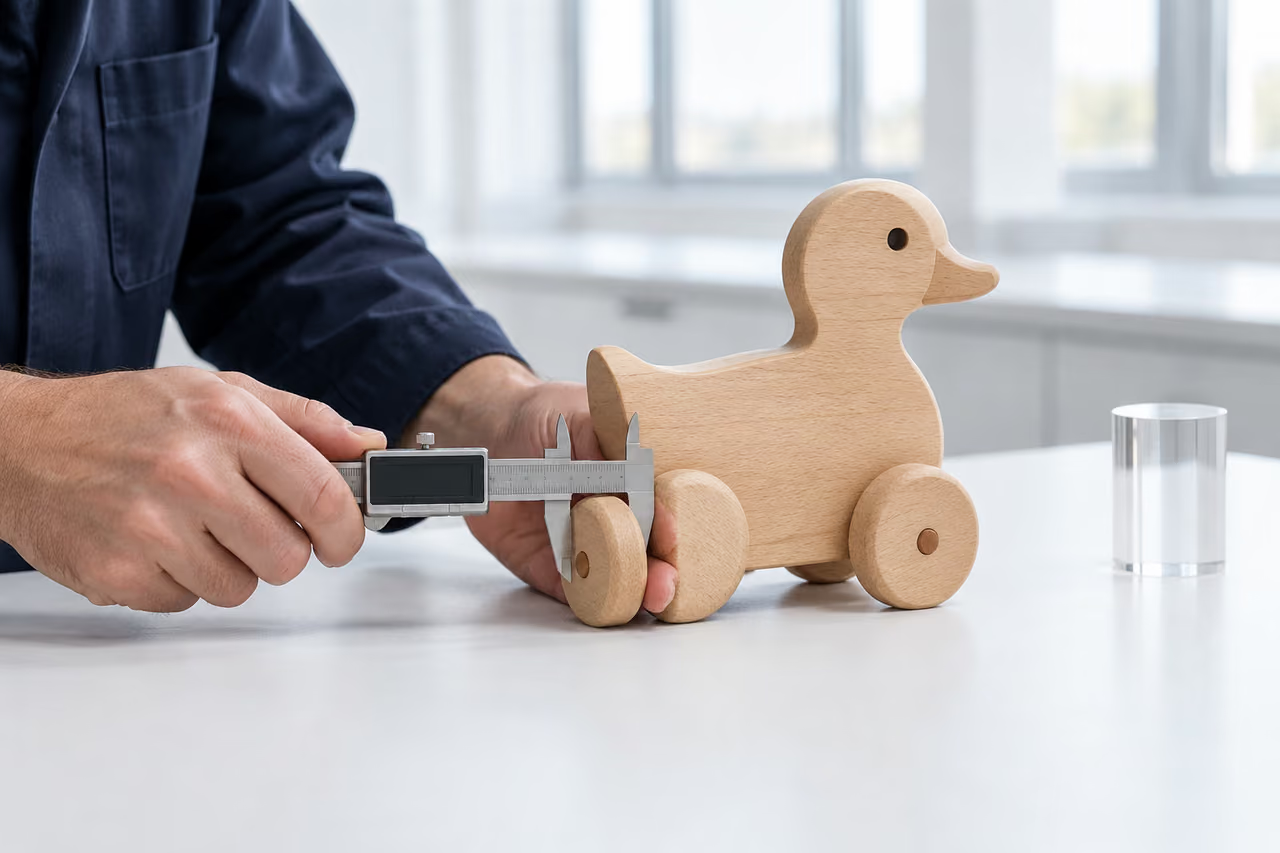
You make wooden toys in Vietnam or plush animals in the U.S. and want to sell them in the EU, through distributors or your own online shop. Each toy needs CE marking before it is placed on the market, under the Toy Safety Directive 2009/48/EC, which applies until 31 July 2030. This guide to CE marking for toys covers the six steps, from the safety assessment to the business in the EU that holds your documents.
Is your product a toy under EU law?
The Directive covers products designed or intended, whether or not exclusively, for use in play by children under 14 (Article 2(1) of Directive 2009/48/EC (opens in a new tab)). Annex I excludes, for example, collectors' items marked for collectors aged 14 and above, puzzles with more than 500 pieces and electrical transformers for toys. Article 2(2) takes some toys out of its scope, such as playground equipment for public use and toy vehicles with combustion engines.
Step 1: assess every hazard before you test
Before placing a toy on the market, analyze the chemical, physical, mechanical, electrical, flammability, hygiene and radioactivity hazards it may present and the potential exposure to them (Article 18). Annex II sets the particular requirements, for example:
- toys for children under 36 months and their detachable parts must be too large to be swallowed or inhaled (Part I, point 4(d));
- CMR substances (carcinogenic, mutagenic or toxic for reproduction) are banned unless an exception applies, and migration limits apply to elements such as lead (Part III, points 3 to 7 and 13);
- textile toys for children under 36 months must be washable, unless soak washing could damage a mechanism inside (Part V, point 2).
According to the Commission's guidance, the scope of testing can be based on the assessment: testing only needs to be considered for substances that can reasonably be expected in the toy.
Step 2: choose the standards and the conformity route
Toys that conform to harmonised standards whose references are published in the Official Journal are presumed to meet the requirements those standards cover (Article 13). Implementing Decision (EU) 2023/740 (opens in a new tab), as amended, lists parts of the EN 71 series, such as EN 71-1 (mechanical and physical properties), EN 71-2 (flammability) and EN 71-3 (migration of certain elements), and EN IEC 62115 for electric toys.
If listed standards cover all relevant safety requirements of the toy and you apply them in full, you use internal production control (module A) without a notified body (Article 19(2)). Article 19(3) requires an EC-type examination by a notified body plus conformity to type where:
- no listed standards cover all relevant safety requirements;
- you apply them only in part or not at all;
- a relevant standard is listed with a restriction, as EN 71-1:2014+A1:2018 has been for wave rollers since 10 September 2025 (Implementing Decision (EU) 2025/1785 (opens in a new tab));
- you consider that the toy needs third-party verification.
Step 3: compile the technical documentation
Under Annex IV, the technical documentation contains, as far as relevant, the design and manufacturing description with materials and suppliers' safety data sheets, the safety assessment, the procedure followed, the declaration, the places of manufacture and storage, and test reports or the EC-type examination certificate.
Draw it up in an official EU language (Article 21(2)) and keep it, with the declaration, for 10 years after the toy is placed on the market (Article 4(3)). An authority can request a translation of relevant parts with a deadline of 30 days, shorter for a serious and immediate risk (Article 21(3)).
Step 4: declaration of conformity and CE marking
The EC declaration of conformity follows the model in Annex III, includes a color image of the toy and is translated into the language each member state requires (Article 15(2)). By drawing it up, you assume responsibility for the toy's compliance (Article 15(3)).
Affix the CE marking visibly, legibly and indelibly to the toy, an affixed label or the packaging before placing the toy on the market (Article 17). If it is not visible from outside, it must at least be on the packaging.
Step 5: traceability details and warnings
| Element | Where | Legal basis |
|---|---|---|
| Type, batch, serial or model number | Toy, else packaging or accompanying document | Article 4(5) |
| Name or trade mark and contact address of manufacturer and, if any, importer | Toy, else packaging or accompanying document | Articles 4(6) and 6(3) |
| EU economic operator's name and contact details, including postal address | Product, packaging, parcel or accompanying document | Article 4(4) of Regulation (EU) 2019/1020 |
| CE marking | Toy, affixed label or packaging | Article 17(1) |
| Warnings, preceded by “Warning” or “Warnings” | Toy, affixed label or packaging; purchase-relevant ones also before purchase | Article 11(2) |
Where appropriate for safe use, warnings specify user limitations, at least a minimum or maximum age (Article 11(1), Annex V, Part A). Part B sets specific warnings for categories such as activity, chemical and aquatic toys; points 2 to 10 must be used word for word. Toys that might be dangerous for children under 36 months carry a warning such as “Not suitable for children under 36 months”, or the pictogram, with a brief indication of the specific hazard.
Each member state decides the language (Articles 4(7) and 11(3)); Germany requires German (§ 11(5) 2. ProdSV (opens in a new tab), the German toy ordinance).
Step 6: an economic operator in the EU
The Toy Safety Directive is listed in Article 4(5) of Regulation (EU) 2019/1020 (opens in a new tab), so toys may only be placed on the market if an economic operator established in the EU performs the tasks in Article 4(3), from keeping the declaration available to cooperating with authorities. For a non-EU manufacturer, that is an importer, an Authorized Representative with a written mandate or, only if neither exists, a fulfilment service provider (Article 4(2); see the role of an economic operator).
Compliant design and manufacture and drawing up the technical documentation cannot be part of a representative's mandate (Article 5(2) of Directive 2009/48/EC). If customs controls find the operator's name and postal address missing, release for free circulation is suspended (Article 26(1)(d) of Regulation (EU) 2019/1020).
The General Product Safety Regulation (EU) 2023/988 applies only in part: its Chapter III, Section 1, including the Responsible Person of Article 16, does not apply to toys (Article 2(1)). Online offers must still show the manufacturer and the EU operator, each with postal and electronic address, a picture of the toy and its warnings (Article 19), and accidents must be notified through the Safety Business Gateway (Article 20).
Electronic toys: further CE legislation
Toys may not be powered by a nominal voltage above 24 volts DC or the equivalent AC voltage (Annex II, Part IV, point 1). Like other consumer electronics, electronic toys can fall under further acts:
| Feature | Further EU act | Note |
|---|---|---|
| Electrical or electronic function | EMC Directive 2014/30/EU, RoHS Directive 2011/65/EU | RoHS lists toys in Annex I, category 7 |
| Radio function, such as a remote control | Radio Equipment Directive 2014/53/EU instead of the EMC Directive | Data protection requirements since 1 August 2025 if the toy can process personal data (Delegated Regulation (EU) 2022/30) |
| Built-in or supplied batteries | Batteries Regulation (EU) 2023/1542 (opens in a new tab) | Also covers batteries incorporated into products (Article 1(3)) |
With the EMC or Radio Equipment Directive, a single declaration covers all acts that require one (Article 15(3) of Directive 2014/30/EU, Article 18(3) of Directive 2014/53/EU).
Practical example: a Vietnamese toy maker
A Vietnamese maker sells wooden and ride-on toys through its own online shop, shipped from an EU fulfilment warehouse. Without an EU importer, it appoints an Authorized Representative.
| Toy | Key requirements in Annex II | Route |
|---|---|---|
| Pull-along duck, from 12 months | Small parts (Part I, 4(d)), strangulation (Part I, 4(a)), paint migration (Part III, 13) | Module A, if listed standards such as EN 71-1, -2 and -3 cover every hazard found and are applied in full |
| Wave roller ride-on, from 3 years | Moving parts (Part I, 3) | EC-type examination: EN 71-1 is restricted for wave rollers (Article 19(3)(c)) |
Common mistakes with CE marking for toys
- A test report instead of a CE file. Safety assessment, technical documentation and declaration are required too (Articles 4(2) and 18).
- An under 36 months warning to avoid small parts rules. Article 11(1) prohibits specific warnings that conflict with the toy's intended use.
- Warnings only on the box. Purchase-relevant warnings belong in the online offer too, in the member state's language.
- Leaving the technical documentation to the representative. Article 5(2) excludes it from the mandate.
The new Toy Safety Regulation: what changes, and when
Regulation (EU) 2025/2509 (opens in a new tab) entered into force on 1 January 2026 and applies from 1 August 2030 (Article 59), when the Directive is repealed (Article 56); only some provisions, such as those on notified bodies and penalties, apply from 1 January 2026. Toys placed on the market in conformity with the Directive before 1 August 2030 may still be made available afterwards (Article 57(1)). For toys placed on the market from that date, a digital product passport replaces the EC declaration of conformity (Article 19, Recital 54). Our toys page shows both regimes.
Conclusion: CE marking for toys starts with the hazards
CE marking for toys follows a fixed order: hazards, standards and route, documentation, declaration, labels, and a business in the EU that can show the documents to authorities.
Representa supports these steps within the agreed scope and mandate. Our CE marking service identifies the applicable legislation and harmonised standards, coordinates testing and reviews your documentation and labels. As your EU Authorized Representative, we provide our name and address for packaging and the declaration, keep your technical documentation for 10 years and handle authority inquiries. Representa is not a notified body, and you remain the manufacturer.
Frequently asked questions
Do toys need a notified body for CE marking?
Not always. If you apply listed harmonised standards that cover all relevant safety requirements of the toy in full, you use internal production control (module A) without a notified body (Article 19(2) of Directive 2009/48/EC). Otherwise, for example where a relevant standard is listed with a restriction, an EC-type examination by a notified body is required (Article 19(3)).
Which EN 71 standards apply to my toy?
That depends on the toy and its hazards. Implementing Decision (EU) 2023/740, as amended, lists among others EN 71-1 (mechanical and physical properties), EN 71-2 (flammability), EN 71-3 (migration of certain elements) and EN IEC 62115 for electric toys. Your safety assessment under Article 18 shows which are relevant.
Do I need an EU representative to sell toys in the EU?
You need an economic operator established in the EU (Article 4 of Regulation (EU) 2019/1020). That can be an importer, an Authorized Representative with a written mandate or, only if neither exists, a fulfilment service provider. Its name and postal address go on the toy, packaging, parcel or an accompanying document.
In which language must toy warnings be?
Each member state decides (Articles 4(7) and 11(3) of Directive 2009/48/EC); Germany, for example, requires German. Warnings that affect the purchase decision, such as age limits, must be visible before purchase, including online (Article 11(2)).
Can toys made under the Directive be sold after 1 August 2030?
Yes, if they were placed on the market in conformity with Directive 2009/48/EC before 1 August 2030 (Article 57(1) of Regulation (EU) 2025/2509). Toys placed on the market from that date must meet the new Toy Safety Regulation, including the digital product passport.