E-bike CE marking and e-scooter rules in the EU

10 min read
E-bike CE marking and e-scooter rules in the EU: which vehicles need type approval, which fall under machinery law, and what 2027 brings for batteries.
You build pedelecs, S-pedelecs or stand-up e-scooters in Asia or North America and want to sell them in the EU. First decide the vehicle class: e-bike CE marking under machinery law, or EU type approval as a moped? That sets the rules, the marking and who must be established in the EU. The battery adds its own obligations, and both change in early 2027.
E-bike, S-pedelec or e-scooter: which EU framework applies
EU type approval for two- and three-wheel vehicles follows Regulation (EU) No 168/2013 (opens in a new tab). Its Article 2(2) excludes, among others:
- Point (h): pedal cycles with an auxiliary electric motor of at most 250 W maximum continuous rated power, whose output is cut off when the rider stops pedaling and is progressively reduced and cut off before 25 km/h. These are EPACs (electrically power assisted cycles) or pedelecs;
- Point (i): self-balancing vehicles;
- Point (j): vehicles without a seating position, such as stand-up e-scooters.
Miss one condition, for example with 500 W continuous rated power or assistance beyond 25 km/h, and the model generally needs type approval. Annex I classes pedal cycles with assistance cut off by 25 km/h and up to 1,000 W as L1e-A powered cycles, and S-pedelecs with assistance up to 45 km/h as L1e-B two-wheel mopeds. A seat can change the result too: point (k) excludes L1e vehicles only if the seating reference point (R-point) is at most 540 mm high.
Electric vehicles outside the Regulation are generally machinery. The Machinery Directive 2006/42/EC excludes two- and three-wheel vehicles only where the type-approval rules cover them (Article 1(2)(e)); the Commission's guide (§55) places pedelecs and self-balancing scooters under it. Recital 17 of the Machinery Regulation (EU) 2023/1230, applicable from 20 January 2027, names e-bikes and e-scooters without EU type approval as covered.
| Vehicle | Legal framework | Marking | Who must be in the EU |
|---|---|---|---|
| Pedelec (EPAC) | Machinery Directive, from 20 January 2027 Machinery Regulation; EMC, RoHS, WEEE | CE marking | Economic operator (Art. 4, Regulation (EU) 2019/1020) |
| Stand-up e-scooter | As for pedelecs | CE marking | As for pedelecs |
| S-pedelec, assistance up to 45 km/h | Regulation (EU) No 168/2013, category L1e-B | EU type approval, certificate of conformity | Representatives under Art. 9(4) and (5) |
| LMT battery | Battery Regulation (EU) 2023/1542 | CE marking on the battery; passport from 18 February 2027 | Economic operator (Art. 4, Regulation (EU) 2019/1020) |
Road use is national law
Machinery law covers the product, not traffic: Recital 17 leaves out risks from circulation on public roads. Whether and how e-bikes and e-scooters may use public roads is national law; some member states require insurance, lighting or a national approval. Check each target market before you fix the specification.
E-bike CE marking: what machinery law requires
Pedelecs and e-scooters are not listed in Annex IV of the Directive, so you assess conformity yourself with internal checks under Annex VIII (Article 12(2)), without a notified body. You need the technical file, instructions, the EC declaration of conformity and the CE marking (Article 5(1)). The declaration names a person authorized to compile the technical file who is established in the EU (Annex II, part 1, section A, point 2).
Further rules for the vehicle:
- EMC: Directive 2014/30/EU (opens in a new tab) applies to the vehicle (Article 2(1)), unless built-in radio makes it radio equipment (Article 2(2)(a)).
- Low Voltage Directive: not for the vehicle, because machinery law alone governs its electrical hazards (Annex I, 1.5.1). A mains charger is in its scope (Commission LVD guide (opens in a new tab), §6).
- RoHS and WEEE: both exclude means of transport, but not electric two-wheel vehicles without type approval (Article 2(4)(f) of Directive 2011/65/EU, Article 2(4)(d) of Directive 2012/19/EU). Substance limits apply, and producers register in each member state (Article 16 WEEE).
- Radio: Bluetooth, GPS or mobile network modules bring in the Radio Equipment Directive 2014/53/EU, which then also covers EMC (Article 3(1)(b)).
- GPSR: the General Product Safety Regulation (opens in a new tab) adds its rules on online offers and accident notifications (Articles 19 and 20).
From 20 January 2027, the Regulation applies to every unit placed on the market; units placed on the market under the Directive before then may still be made available (Article 52(1)). Internal checks remain (module A, Article 25(4)), the declaration follows Annex V, and products non-professionals may use need the essential safety information on paper (Article 10(7)). See our Machinery Regulation checklist.
The battery: its own product, its own CE marking
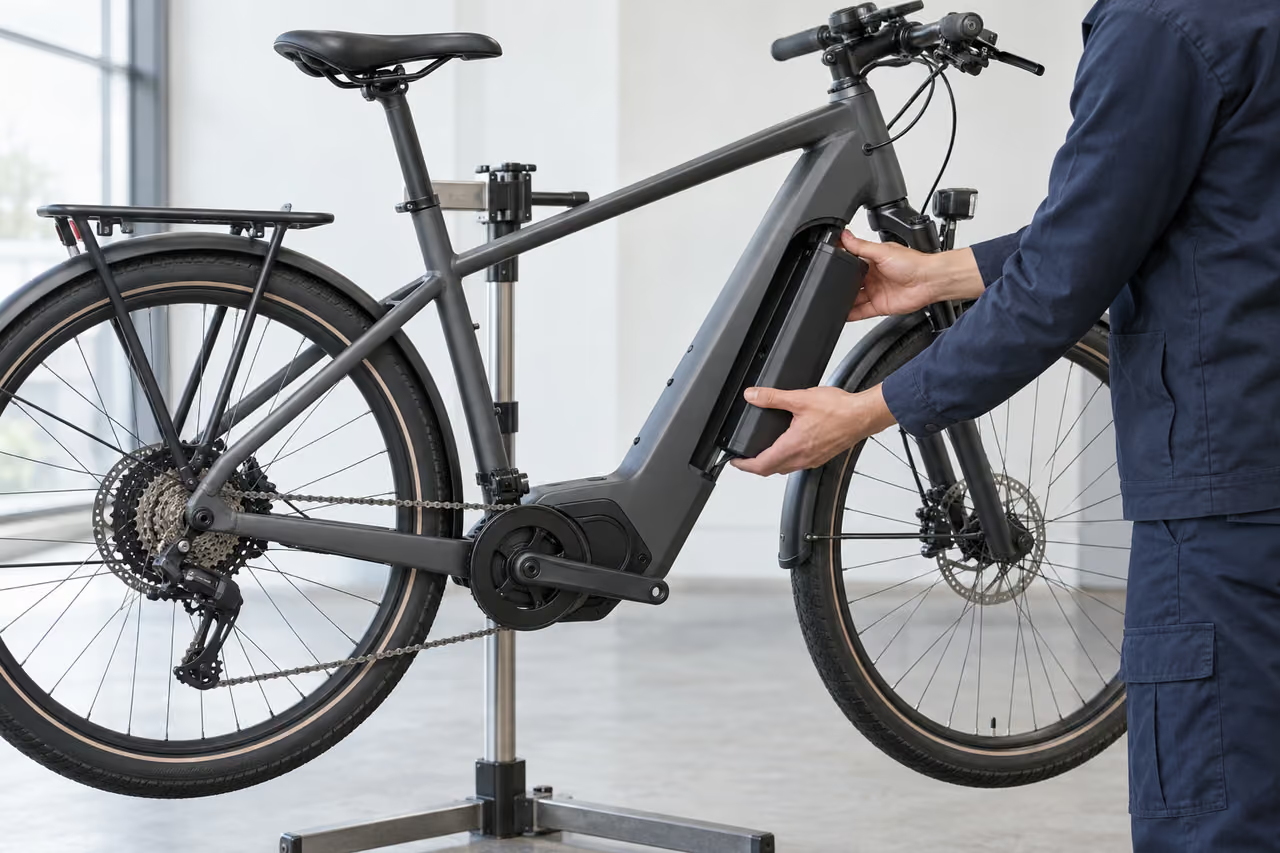
The traction battery is an LMT battery (light means of transport battery): sealed, at most 25 kg and designed to power wheeled vehicles driven by an electric motor alone or with human power, including type-approved L-category vehicles (Article 3(1), point (11), of Regulation (EU) 2023/1542 (opens in a new tab)). Recital 15 names e-bikes and e-scooters.
Since 18 August 2024, the battery's manufacturer draws up technical documentation, carries out the conformity assessment (module A or D1 for series production, Article 17(1)), issues an EU declaration of conformity and affixes the CE marking to the battery (Articles 38(2), 38(3) and 96(2)(b)). The manufacturer is whoever markets the battery under its own name or trademark (Article 3(1), point (33)): if your brand is on the pack, that is you. LMT batteries also need:
- performance and durability values in an accompanying document (Article 10(1));
- state-of-health data in the battery management system (Article 14);
- the separate collection symbol, since 18 August 2025 (Article 13(4)).
Extended producer responsibility (EPR) has applied since 18 August 2025 (Article 96(2)(c)): producers register in each member state where they first make batteries available, including those in light means of transport (Article 55(2)), and distance sellers to end users appoint an authorized representative for EPR in each such member state (Article 56(3)). Representa supports this role as part of Representation and the registrations as part of Compliance.
What changes for e-bike batteries on 18 February 2027
- Battery passport: an electronic record for every LMT battery placed on the market (Article 77(1)), kept accurate and up to date by the economic operator placing it on the market (Article 77(4)).
- QR code on the battery giving access to the passport (Article 13(6)).
- Replaceability: whoever places e-bikes or e-scooters on the market ensures that the battery and the individual cells in the pack are readily removable and replaceable by an independent professional throughout the product's lifetime (Article 11(5)).
- Spare batteries for at least five years after the last unit of the model is placed on the market, at a reasonable and non-discriminatory price (Article 11(7)), and no software that impedes replacement with a compatible battery (Article 11(8)).
The Commission's guidelines on removability (opens in a new tab) (C/2025/214) describe independent professionals as independent operators with the technical competence to repair the product, working on a commercial basis. Special tools should be available to them at a reasonable and non-discriminatory price.
Who must be established in the EU
Machinery and, through Article 91 of the Battery Regulation, batteries are listed in Article 4(5) of Regulation (EU) 2019/1020 (opens in a new tab). Pedelecs, e-scooters and their batteries therefore need an economic operator established in the EU for the tasks in Article 4(3), such as keeping the declaration of conformity available and answering authorities.
That operator is the manufacturer in the EU, an importer, an Authorized Representative with a written mandate or, as a fallback, a fulfilment service provider (Article 4(2); see Authorized Representative or importer). Its name and contact details, including the postal address, go on product, packaging, parcel or accompanying document (Article 4(4)); if customs find them missing, they suspend release (Article 26(1)(d)). Drawing up the technical documentation stays with the manufacturer: Article 40(2) of the Battery Regulation, and from 20 January 2027 Article 12(1) of the Machinery Regulation, exclude it from the mandate.
For S-pedelecs, a manufacturer outside the EU appoints a single EU representative before the approval authority and one for market surveillance, possibly the same (Article 9(4) and (5) of Regulation (EU) No 168/2013). This type-approval role is separate from the Authorized Representative under product law.
Seven steps before your first shipment
- Classify each model: power, cut-off speed, pedal-only assistance, seat.
- List the rules for vehicle, battery and charger separately.
- Close the standard gaps in your risk assessment: vibration for pedelecs, every relevant requirement for e-scooters.
- Settle who manufactures the battery and request cell and module data from suppliers, who must provide it free of charge (Article 39 of the Battery Regulation).
- Appoint your EU economic operator and label its details.
- Clarify who registers for WEEE and battery EPR in each sales country.
- Plan for 2027: new declaration and paper safety information from 20 January; passport, QR code and replaceable cells from 18 February.
Common mistakes with e-bikes and e-scooters
- Treating every e-bike as a bicycle. Above 250 W or 25 km/h, type approval generally applies.
- Naming the Low Voltage Directive for the bike. It concerns the mains charger.
- Forgetting the battery's own CE marking and declaration (Article 18 of the Battery Regulation).
- Confusing product law with road law. CE marking does not make an e-scooter road-legal everywhere.
Conclusion: classify first, then plan for 2027
Classify each model first, then plan design and documents for both 2027 dates together. Our pages on machinery, batteries and e-mobility summarize the rules.
Representa supports you within the agreed scope and mandate. Our CE marking service helps you identify the applicable legislation and harmonized standards and compile and review your technical documentation. As your EU Authorized Representative, we provide our name and address for packaging and the Declaration of Conformity, keep your technical documentation for 10 years and handle authority inquiries. You remain the manufacturer.
Frequently asked questions
Do e-bikes need CE marking in the EU?
Pedelecs with at most 250 W continuous rated power, whose motor assists only while pedaling and cuts off before 25 km/h, are excluded from type approval (Article 2(2)(h) of Regulation (EU) No 168/2013). They are machinery and carry CE marking under Directive 2006/42/EC, from 20 January 2027 under Regulation (EU) 2023/1230. The battery carries its own CE marking.
Do stand-up e-scooters need EU type approval?
No. Regulation (EU) No 168/2013 does not apply to vehicles without a seating position (Article 2(2)(j)). Stand-up e-scooters fall under machinery law and carry CE marking. Whether and under which conditions they may be ridden on public roads is decided by each member state.
Is an S-pedelec a bicycle under EU law?
No. A pedelec with assistance up to 45 km/h is a two-wheel moped of category L1e-B (Annex I of Regulation (EU) No 168/2013) and needs type approval, as a rule EU type approval (small series may get national approval, Article 42). Each EU-approved vehicle comes with a certificate of conformity, and a manufacturer outside the EU appoints a representative in the EU (Article 9(4) and (5)).
What changes for e-bike batteries on 18 February 2027?
Each LMT battery placed on the market needs a battery passport reachable by QR code (Articles 77(1) and 13(6) of Regulation (EU) 2023/1542). The battery and its cells must be readily removable and replaceable by an independent professional, and spare batteries must be available for five years after the last unit of the model (Article 11(5) and (7)).
Does the Low Voltage Directive apply to e-bikes?
Not to the e-bike itself. Machinery law alone governs its electrical hazards (Annex I, 1.5.1, of Directive 2006/42/EC; Annex III, 1.5.1, of Regulation (EU) 2023/1230), and Directive 2014/35/EU covers direct current only from 75 V. A mains charger supplied with the bike is in the scope of the Low Voltage Directive, according to the Commission's LVD guide.