
EV charger CE marking: EU rules for wallboxes

10 min read
EV charger CE marking explained: LVD, EMC or RED, RoHS, WEEE, RED cybersecurity, the Cyber Resilience Act, AFIR and who must be based in the EU.
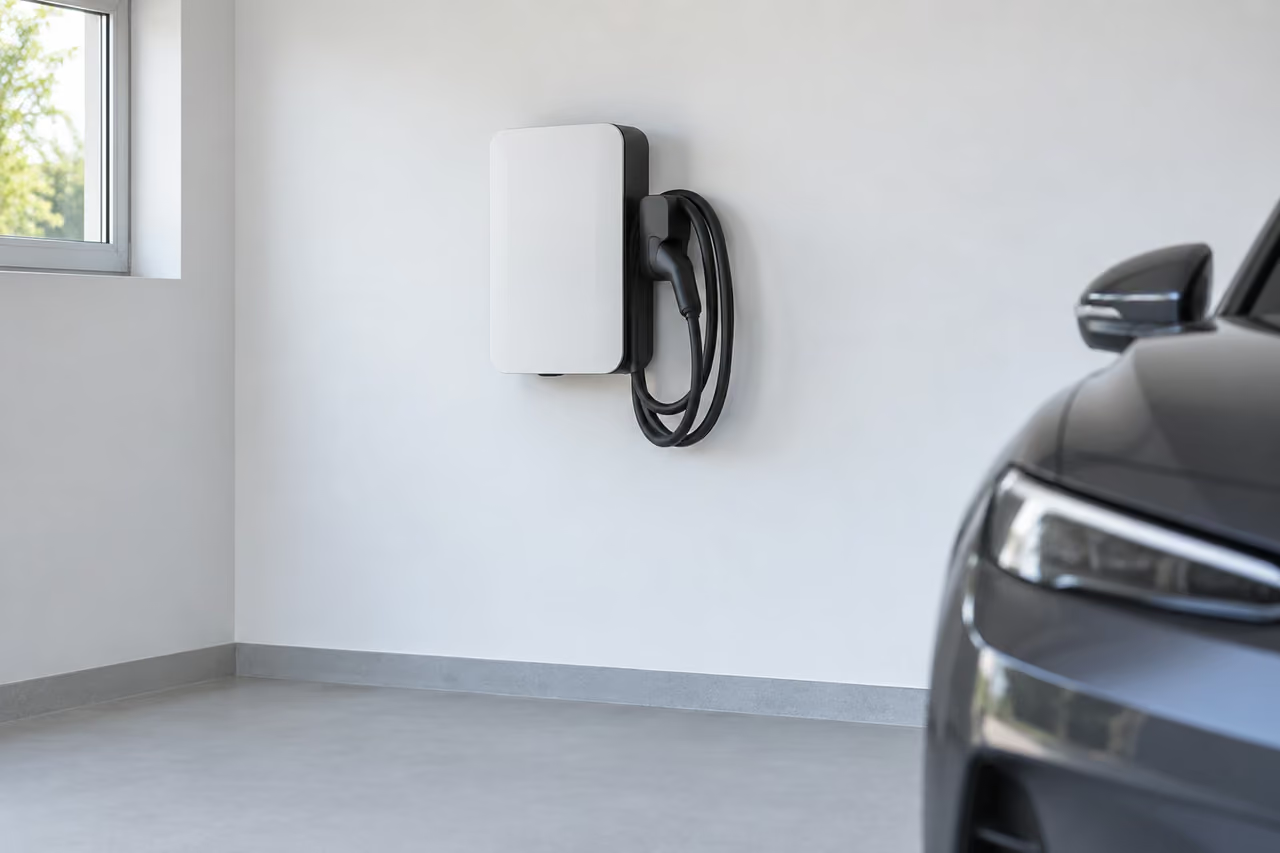
You build AC wallboxes or DC chargers in China, the U.S. or Canada and want to sell them in the EU. EV charger CE marking is not one directive but a stack of rules: electrical safety, electromagnetic compatibility, radio, hazardous substances, cybersecurity, take-back and charging infrastructure. Which apply depends on your charger's features; even an RFID card reader changes the legal basis.
EV charger CE marking: the features decide the rules
A wallbox without radio falls under the Low Voltage Directive 2014/35/EU (opens in a new tab) (LVD), which covers 50 to 1,000 V AC and 75 to 1,500 V DC (Article 1), and the EMC Directive 2014/30/EU on electromagnetic interference. For both, you assess conformity yourself through internal production control, known as module A (Annex III LVD, Article 14(a) EMC Directive), without a notified body, the independent test body some EU rules require.
| Feature | Legal act | What it triggers |
|---|---|---|
| Mains connection, no radio | LVD 2014/35/EU, EMC Directive 2014/30/EU | Safety and EMC under module A, CE marking |
| Wi-Fi, mobile, Bluetooth or RFID reader | Radio Equipment Directive 2014/53/EU (RED) | Replaces the LVD and EMC Directive |
| Radio plus an internet link | Delegated Regulation (EU) 2022/30 | Cybersecurity requirements since 1 August 2025 |
| Data connection to a device or network | Cyber Resilience Act (EU) 2024/2847 | Reporting from 11 September 2026, in full from 11 December 2027 |
| Electronics | RoHS Directive 2011/65/EU | Limits for ten substances |
| Sale to users in an EU country | WEEE Directive 2012/19/EU, national law | Producer registration per country, bin symbol |
| Installation as a charging point | AFIR, Regulation (EU) 2023/1804 | Interoperability standards; duties of public operators |
Wi-Fi, mobile, Bluetooth or RFID: when the RED takes over
The Radio Equipment Directive 2014/53/EU (opens in a new tab) covers electrical or electronic products that intentionally emit or receive radio waves, meaning waves below 3,000 GHz, for radio communication (Article 2(1)(1) and (4)). An RFID card reader is enough: it emits radio waves to read the charging card.
The LVD and the EMC Directive then no longer apply separately (Article 1(4) RED; Article 2(2)(a) EMC Directive, read with Article 50 RED). The RED instead requires the LVD safety objectives with no voltage limit, EMC and efficient use of the radio spectrum (Article 3(1)(a) and (b), Article 3(2)).
Safety and EMC can always be assessed under module A (Article 17(2)). For spectrum and cybersecurity, module A requires harmonized standards published in the Official Journal and applied in full; otherwise a notified body is involved (Article 17(3) and (4)). You assess the wallbox itself as radio equipment (Article 17(1)), so test reports for a pre-approved radio module help but do not replace that assessment.
The instructions state frequency bands and maximum transmitted power (Article 10(8)); one Declaration of Conformity lists all acts, such as the RED and RoHS (Article 18(3)), and each unit comes with a copy or a simplified version (Article 10(9)).
Cybersecurity: RED delegated act first, Cyber Resilience Act next
Delegated Regulation (EU) 2022/30 (opens in a new tab), as amended by Delegated Regulation (EU) 2023/2444, has applied three further RED requirements to internet-connected radio equipment since 1 August 2025:
- network protection, Article 3(3)(d) RED, in all cases (Article 1(1));
- data protection, Article 3(3)(e), if it can process personal, traffic or location data, such as charging sessions linked to a user account (Article 1(2));
- fraud protection, Article 3(3)(f), if users can transfer money, monetary value or virtual currency with it (Article 1(3)).
The link need not use the radio: in our reading, a wallbox with an RFID reader that reaches its backend over Ethernet is covered, and guidance of the market surveillance authorities (ADCO RED) treats an NFC module plus a LAN port the same way. Bluetooth to a phone app alone is not automatically enough; Recital 5 looks at whether the equipment itself operates the protocols to exchange data with the internet.
Delegated Regulation (EU) 2026/339 repeals Delegated Regulation 2022/30 with effect from 11 December 2027, when the Cyber Resilience Act (opens in a new tab) (CRA) applies in full (Article 71(2) CRA).
What the Cyber Resilience Act adds
The CRA covers products with digital elements whose intended or foreseeable use includes a direct or indirect data connection to a device or network (Article 2(1)). A cloud backend that you develop, or have developed under your responsibility, and without which the wallbox cannot perform one of its functions, is part of the product (Article 3(1) and (2)).
Wallboxes are not named in Annexes III or IV. The core functionality of the product as a whole decides; a built-in part from a listed category, such as an authentication reader or a microcontroller with security functions, does not change that (Article 7(1)). Internal control (module A) is therefore available (Article 32(1)).
From 11 September 2026, you report actively exploited vulnerabilities and severe incidents, with an early warning within 24 hours (Article 14), also for wallboxes already on the market (Article 69(3)). From 11 December 2027, new units must meet the essential requirements, with at least five years of security support unless the expected use is shorter (Article 13(8)).
RoHS and WEEE: substances and take-back
A wallbox needs electric current to work, so it is electrical and electronic equipment (EEE) under Article 3(1) of RoHS Directive 2011/65/EU (opens in a new tab). Annex II, as replaced by Delegated Directive (EU) 2015/863, limits ten substances, including lead and four phthalates, to 0.1 % by weight in homogeneous materials (cadmium 0.01 %), unless an exemption applies (Article 4). Module A and the same declaration cover this (Article 7).
The WEEE Directive 2012/19/EU has covered all EEE outside its listed exclusions since 15 August 2018 (Article 2(1)(b)). The producer, typically the importer or a seller supplying end users by distance sales (Article 3(1)(f)), registers in each country (Article 16) and marks the product with the crossed-out bin (Article 14(4)).
For sellers outside the EU, national law decides whether a WEEE authorized representative is required. Germany, for example, requires one from producers without an establishment in Germany, including those selling directly to end users (§ 8 ElektroG (opens in a new tab)).
AFIR: what charging infrastructure must support
The Alternative Fuels Infrastructure Regulation (EU) 2023/1804 (AFIR) has applied since 13 April 2024 (Article 26). Its payment and connectivity duties bind the operator of publicly accessible recharging points: at points deployed from 13 April 2024, electronic payment by card reader, contactless device or, below 50 kW, also an internet-based option such as a QR code (Article 5(1)), plus digital connection and smart recharging (Article 5(7) and (8)). Expect these features in tenders.
Annex II, as amended by Delegated Regulation (EU) 2025/656 (opens in a new tab), reaches further: public points installed or renovated from 1 January 2027 must comply with EN ISO 15118-20:2022, and so must private recharging points installed or renovated from 1 January 2027 for Mode 3 or Mode 4 recharging (points 2.1.2 and 2.1.3), the modes AC wallboxes and DC chargers use.
Who must be based in the EU for your wallbox
The LVD, EMC Directive, RED and RoHS are listed in Article 4(5) of Regulation (EU) 2019/1020 (opens in a new tab). Your wallbox may only be placed on the EU market if an economic operator established in the EU is responsible for it (Article 4(1)): an EU manufacturer, an importer, an Authorized Representative with a written mandate or, as a last resort, a fulfillment service provider (Article 4(2)).
That operator keeps the Declaration of Conformity available, provides documents to authorities and cooperates on corrective action (Article 4(3)). Its name and postal address go on the product, packaging, parcel or an accompanying document (Article 4(4)); if customs find them missing, they suspend release (Article 26(1)(d)). If you sell wallboxes for home use online, the offer must also name the manufacturer and this operator with postal and electronic address (Article 19 of the General Product Safety Regulation (EU) 2023/988 (opens in a new tab)).
Under the RED, design and drawing up the technical documentation cannot be delegated to your Authorized Representative (Article 11(1)). Our article on Authorized Representative or importer compares the options.
Five steps before your first EU shipment
- Map features to acts: radio including RFID, internet link, payment, public or private use; then LVD and EMC or the RED, RoHS and cybersecurity.
- Test against standards cited in the Official Journal, minding the EN 18031 restrictions, or plan a notified body.
- Issue one Declaration of Conformity, affix the CE marking and translate the instructions into the languages member states require.
- Appoint your EU economic operator and register for WEEE where you are the producer.
- Plan ahead for CRA reporting from 11 September 2026, CRA conformity from 11 December 2027 and EN ISO 15118-20:2022.
Conclusion: map the features, then the roles
Radio, internet, payment and place of installation decide which acts apply to your charger. Our pages on e-mobility, electronics and wireless devices summarize the related rules.
Our CE marking support identifies the applicable directives and harmonized standards and reviews your technical documentation. As your EU Authorized Representative, Representa provides its name and address for packaging and the Declaration of Conformity, keeps your documentation for 10 years and handles authority inquiries, within the agreed scope and mandate; you remain the manufacturer. WEEE registration and an authorized representative for WEEE are part of our Compliance and Representation pillars.
Frequently asked questions
Does an EV wallbox need CE marking?
Yes. A wallbox without radio needs CE marking under the Low Voltage Directive 2014/35/EU and the EMC Directive 2014/30/EU; with Wi-Fi, mobile, Bluetooth or an RFID reader, under the Radio Equipment Directive 2014/53/EU instead. RoHS Directive 2011/65/EU applies in both cases, and one EU Declaration of Conformity lists all acts.
Is a wallbox with an RFID card reader radio equipment?
Yes. The reader intentionally emits radio waves to communicate with the card, which meets the definition in Article 2(1)(1) of Directive 2014/53/EU. The whole wallbox then falls under the RED, which covers electrical safety and EMC (Article 3(1)), and the LVD no longer applies separately (Article 1(4)).
Do the RED cybersecurity rules apply to my wallbox?
They have applied since 1 August 2025 to wallboxes that are radio equipment and can communicate themselves over the internet, directly or via other equipment (Article 1(1) of Delegated Regulation (EU) 2022/30). In the guidance of the market surveillance authorities (ADCO RED), the internet link may also run over a cable. From 11 December 2027 the Cyber Resilience Act replaces these requirements.
Do I need an EU Authorized Representative for EV chargers?
You need an economic operator established in the EU, because the LVD, EMC Directive, RED and RoHS are listed in Article 4(5) of Regulation (EU) 2019/1020. Without an EU importer or EU manufacturer, that is usually an Authorized Representative with a written mandate. Its name and postal address go on the product, packaging, parcel or an accompanying document.
Does AFIR apply to home wallboxes?
Partly. The payment and connectivity duties in Article 5 of Regulation (EU) 2023/1804 bind operators of publicly accessible charging points. But under Annex II, as amended by Delegated Regulation (EU) 2025/656, private charging points installed or renovated from 1 January 2027 must comply with EN ISO 15118-20:2022 for Mode 3 or Mode 4 recharging.