Is it a toy? EU rules for borderline products

9 min read
Is it a toy under EU law? How the Toy Safety Directive and Commission guidance classify borderline products, and what follows: CE marking or the GPSR.
You make figurines, plush keyrings, costumes or craft kits outside the EU and want to sell them in Europe. Before you test, label or appoint anyone, one question sets the route: is it a toy under EU law? If yes, the Toy Safety Directive 2009/48/EC applies, with CE marking and an EU economic operator. If not, the product usually falls under the General Product Safety Regulation (EU) 2023/988 (GPSR) and needs a Responsible Person.
Is it a toy? The test in Article 2(1)
Article 2(1) of Directive 2009/48/EC (opens in a new tab) covers products designed or intended, whether or not exclusively, for use in play by children under 14 years of age. Three parts of the definition decide most cases:
- Use in play: Almost everything has some play value for a child; it counts when the manufacturer introduced it intentionally (the Commission's Guidance document No 4).
- Whether or not exclusively: A product with a second function can be a toy, such as a key ring with a teddy bear attached (explanatory guidance document, point 1.2.1).
- Children under 14: Being made for children is not enough; a children's bicycle is not automatically a toy (Guidance document No 14).
Your declared purpose counts but does not decide: the reasonably foreseeable use prevails over the declaration of intended use, and a manufacturer who labels a product as not being a toy must be able to support this claim (Guidance document No 4).
What the Directive excludes: Article 2(2) and Annex I
Article 2(2) excludes five kinds of toys, such as playground equipment intended for public use and toy vehicles with combustion engines. Annex I lists products that are not considered toys, among them:
- decorative objects for festivities and celebrations (point 1);
- products for collectors, provided the product or its packaging bears a visible and legible indication that it is intended for collectors of 14 years of age and above, such as detailed and faithful scale models (point 2);
- sports equipment, including roller skates, inline skates and skateboards, intended for children with a body mass of more than 20 kg (point 3);
- puzzles with more than 500 pieces (point 8);
- babies' soothers, child-appealing luminaires and fashion accessories for children which are not for use in play (points 16, 17 and 19).
Annex I only gives examples: a product missing from it is not automatically a toy (explanatory guidance document, point 10).
How to classify your product in six steps
- Check Article 2(2). For the five excluded toys, other EU legislation or the GPSR applies.
- Check Annex I with its conditions. A puzzle is excluded only above 500 pieces, a skateboard only for children over 20 kg, a collector item only with the collector indication.
- Apply Article 2(1). Did you build in play value for children under 14, even as a second function?
- Test the foreseeable use against the indicative criteria of Guidance document No 4: place of sale, packaging and advertising aimed at children, price, size, and whether the product stays out of children's reach. Use them together, not in isolation.
- Read the guidance for your product group. Guidance documents cover, among others, decorative and collector products (No 20), books (No 9), craft kits (No 13), sports equipment (No 14) and costumes (No 17).
- Record the decision and the reasons. Guidance document No 4 states that manufacturers are responsible for the classification; market surveillance authorities can challenge it.
Borderline products in the guidance
The guidance documents are not binding; authorities decide case by case.
| Product | Classification | Why |
|---|---|---|
| Plush figure on a keyring | Toy | Dual function (explanatory guidance document, point 1.2.1) |
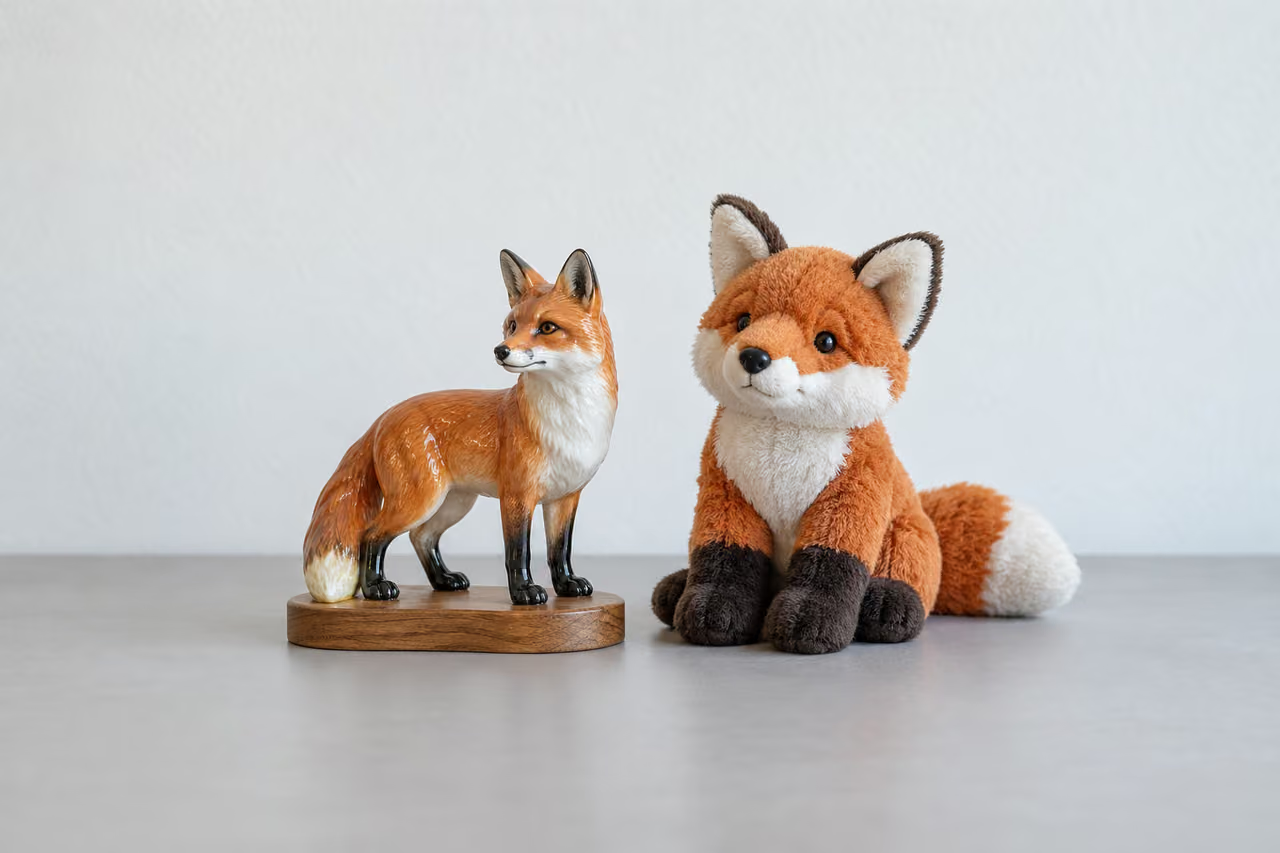
| Ceramic or resin figurine on a base | Not a toy | Hard or breakable material, pedestal, low play value (Guidance document No 20, Annexes 1 and 6) |
| Low-priced vinyl character figure | Toy | Low price, attractive to children under 14, play value (No 20, Annex 6) |
| Carnival costume in children's sizes | Toy | Used in role play; adult sizes and costumes for babies up to one year are not toys (No 17) |
| Football | Depends | Official and training balls are sports equipment; balls with major material changes for children's play are toys (No 14) |
| Jigsaw puzzle with 1,000 pieces | Not a toy | More than 500 pieces (Annex I, point 8) |
| Craft kit | Depends | Toy if playful handling is the main purpose; not a toy if the purpose is a homemade product made with a technique such as embroidery, without playful handling (No 13) |
| Children's book | Depends | Ordinary reading and educational books are not toys; fabric, sound, coloring and simple sticker books are (No 9) |
| Babies' soother | Not a toy | Annex I, point 16; the GPSR applies fully to childcare articles (GPSR guidelines, point 2.2) |
What follows: toy rules or the GPSR
Toys fall under Union harmonisation legislation, so Chapter III, Section 1 of the GPSR (Articles 9 to 18, including the Responsible Person) does not apply to them (Article 2(1) GPSR (opens in a new tab)).
| Topic | Toy (Directive 2009/48/EC) | Not a toy (GPSR) |
|---|---|---|
| Before sale | Safety assessment, conformity assessment, EC declaration of conformity, CE marking (Articles 4(2), 18 and 19) | Internal risk analysis and technical documentation (Article 9(2)); no CE marking unless other CE legislation applies |
| EU business | Economic operator under Article 4 of Regulation (EU) 2019/1020; name and postal address on product, packaging, parcel or accompanying document | Responsible Person under Article 16; name, postal and electronic address in the same places |
| Warnings | Where appropriate, user limitations such as minimum or maximum age (Article 11(1), Annex V Part A), visible before purchase, also online (Article 11(2)) | Instructions and safety information in the language set by the member state (Article 9(7)) |
| Documents | Technical documentation and declaration kept for 10 years (Article 4(3)) | Technical documentation kept for 10 years (Article 9(3)) |
Both routes share the GPSR rules for online offers (Article 19), accident notifications through the Safety Business Gateway (Article 20) and online marketplaces (Article 22). See Authorized Representative or importer for who can take the EU role.
Practical example: one fox design, three products
A Vietnamese gift maker plans a fox range for the EU:
- Painted ceramic fox on a display base, sold in gift shops: usually not a toy, so the GPSR applies. The risk analysis still considers children, as the design may appeal to them (Article 6(1)(f)(ii) GPSR).
- Plush fox: a toy, with CE marking, required warnings and an EU economic operator.
- The same plush fox on a keyring: still a toy.
One EU business can take both roles, under Article 4 of Regulation (EU) 2019/1020 and Article 16 GPSR, if its written mandate covers all three products. Our pages on toys, consumer products without CE marking and consumer goods and electronics list further rules.
From 1 August 2030: the Toy Safety Regulation
Regulation (EU) 2025/2509 (opens in a new tab) replaces the Directive from 1 August 2030 and applies directly (Articles 56 and 59). It keeps the definition and adds that a product counts as intended for play by children under 14 where a parent or supervisor can reasonably assume so from its functions, dimensions and characteristics (Article 2(1)).
In Annex I, decorative objects are excluded only without play value, only continuously wired child-appealing luminaires stay excluded, and paint ball equipment and reading and educational books for children over 36 months without play value are added. The Commission can also decide by implementing acts whether specific products are toys (Article 2(3)).
Common mistakes when classifying
- Overlooking dual use. Soft toys on a key ring, animal-shaped cushions and soft-filled backpacks can be toys (Guidance document No 11).
- Adding CE marking “to be safe”. It may only be affixed where EU legislation provides for it (Article 30(2) of Regulation (EC) No 765/2008).
- Assuming a non-toy needs no safety work. The GPSR risk analysis takes children into account where they are likely users (Articles 6 and 9(2)).
Conclusion: classify first, then build the file
Is it a toy? Answer that per product before testing, labeling or listing, record why, and check again when design, packaging or sales channels change.
Representa supports you within the agreed scope and mandate. Our CE marking support identifies the applicable directives and harmonized standards. For toys we can act as your EU Authorized Representative, for other consumer products as your GPSR Responsible Person. The classification and the product remain your responsibility as manufacturer.
Frequently asked questions
Is a plush keyring a toy under EU law?
Yes, in the Commission's view. Article 2(1) of Directive 2009/48/EC covers products intended for play by children under 14, whether or not exclusively, and the Commission's explanatory guidance names a key ring with a teddy bear attached as a toy. A flat keyring with low or no play value is not a toy in Guidance document No 20.
Does a “not a toy” label take my product out of the Toy Safety Directive?
No. According to the Commission's Guidance document No 4, the reasonably foreseeable use prevails over the declared intended use, and you must be able to support the claim. Guidance document No 20 says marking a product “This is not a toy” goes against the Directive where its annexes suggest the product is a toy.
Are jigsaw puzzles toys in the EU?
Puzzles with more than 500 pieces are not toys (Annex I, point 8 of Directive 2009/48/EC); as consumer products they fall under the GPSR. Puzzles with 500 pieces or fewer are assessed against the general definition in Article 2(1).
Who decides whether my product is a toy?
You classify it first, as manufacturer, before placing it on the market. Market surveillance authorities can challenge that decision and decide case by case. The Commission's guidance documents are not binding but reflect the majority view of its Expert Group on Toy Safety; only the Court of Justice of the EU can give a definitive interpretation (Guidance document No 4).
Does the new Toy Safety Regulation change the definition of a toy?
The core definition stays the same in Regulation (EU) 2025/2509, which replaces the Directive from 1 August 2030. Article 2(1) adds a parent or supervisor test, and Annex I changes in detail, for example by excluding decorative objects only where they have no play value.