Solar inverter and home battery EU compliance

10 min read
Solar inverter and home battery EU compliance: which acts apply to which device, which duties are in force, which start later and who must be in the EU.
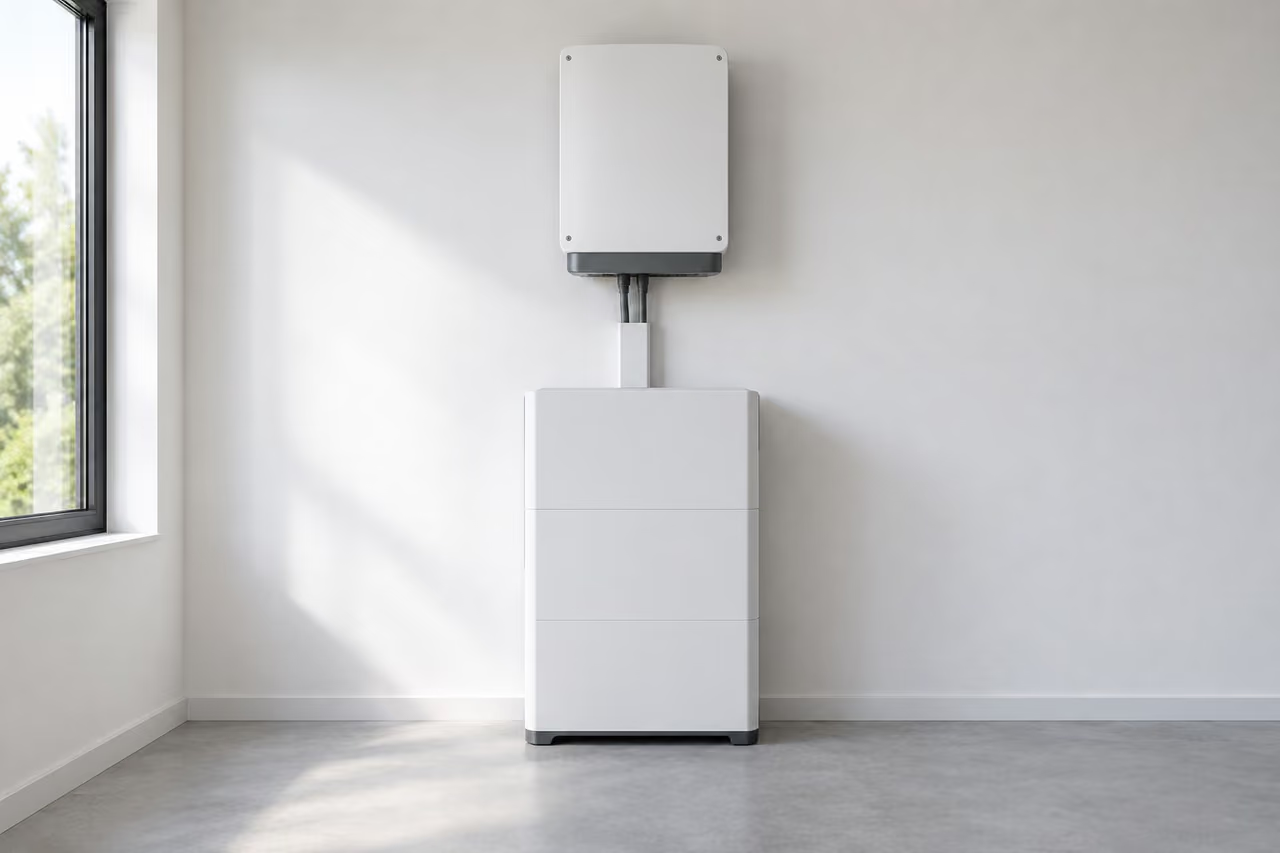
You build hybrid inverters and home batteries in Asia or North America and want to sell them to EU installers and homeowners. Solar inverter EU compliance rests on several acts at once, and the battery has its own regulation with dates into 2027 and later. Here is what applies to which device, from when, and who must be in the EU.
Solar inverter EU compliance: which rules apply to which device
Directives are transposed into national law; regulations apply directly. One EU declaration of conformity covers all acts that require it (Article 15(3) of the Low Voltage Directive 2014/35/EU).
| Device | EU rules | Applies |
|---|---|---|
| Inverter without radio | Low Voltage Directive 2014/35/EU, EMC Directive 2014/30/EU, RoHS Directive 2011/65/EU, WEEE Directive 2012/19/EU | In force |
| Inverter with built-in Wi-Fi or Bluetooth | Radio Equipment Directive 2014/53/EU instead of the Low Voltage and EMC Directives; RoHS and WEEE | In force; cybersecurity rules since 1 August 2025 if internet-connected |
| Inverter or battery with a data connection | Cyber Resilience Act (EU) 2024/2847 | Reporting from 11 September 2026; other manufacturer obligations from 11 December 2027 |
| Home battery | Battery Regulation (EU) 2023/1542 | CE since 18 August 2024; EPR since 18 August 2025; QR code and, above 2 kWh, passport from 18 February 2027 |
| PV modules | WEEE; RoHS unless excluded by Article 2(4)(i) of the RoHS Directive | In force |
Inverters: electrical safety, EMC and hazardous substances
The Low Voltage Directive covers electrical equipment rated between 50 and 1,000 V AC or 75 and 1,500 V DC (Article 1), so a grid-connected inverter at 230 or 400 V AC. Internal production control (Module A, Annex III) suffices, without a notified body; the manufacturer keeps the technical documentation and the declaration for 10 years (Article 6(2) and (3)).
Under the EMC Directive, the manufacturer chooses internal production control or EU-type examination (Article 14). The RoHS Directive limits ten substances, such as lead and cadmium (Article 4, Annex II), checked by internal production control (Article 7).
The WEEE Directive covers all electrical and electronic equipment, with listed exclusions (Article 2(1)(b)). The producer, often your EU importer, registers in each member state of sale (Articles 3(1)(f) and 16); national law decides whether a seller outside the EU needs an authorized representative, and Germany requires one (§ 8 ElektroG).
Wi-Fi, Bluetooth and the cloud: radio and cybersecurity rules
With built-in Wi-Fi or Bluetooth, the inverter is radio equipment (Article 2(1) of Directive 2014/53/EU, the RED). The RED then covers electrical safety, with no voltage limit, and EMC (Article 3(1)(a) and (b)); the Low Voltage and EMC Directives do not apply (Article 1(4) RED; Article 2(2)(a) of Directive 2014/30/EU with Article 50 RED; section 9.5 of the Commission's RED guide (opens in a new tab)). The declaration names the RED and RoHS (Article 18(3) RED).
A readily removable Wi-Fi stick is a separate product under the RED, and the inverter stays under the Low Voltage and EMC Directives (Commission supplementary guidance on the three directives, 26 April 2018).
Since 1 August 2025, internet-connected radio equipment must also protect the network and, where it processes personal data, privacy (Article 3(3)(d) and (e) RED, applied by Delegated Regulation (EU) 2022/30 (opens in a new tab), Article 1). Internet-connected means the inverter can itself communicate over the internet, directly or via other equipment such as a router (Article 1(1) and recital 5). In the joint guidance of the national RED authorities (ADCO RED, 1 February 2026), radio equipment with a LAN port is covered and a stand-alone Bluetooth device is not. So an inverter with Bluetooth for local setup only is usually not covered; one with Bluetooth plus Ethernet to a cloud portal is.
The Cyber Resilience Act (CRA), Regulation (EU) 2024/2847, covers products whose intended or foreseeable use includes a direct or indirect, logical or physical data connection to a device or network (Article 2(1)). Wired RS-485 or Ethernet ports count, and so can a battery whose management system exchanges data with the inverter.
From 11 September 2026, manufacturers report actively exploited vulnerabilities and severe incidents to the national CSIRT (incident response team) and ENISA within 24 and 72 hours, then send a final report (Article 14). The other manufacturer obligations apply from 11 December 2027 to units placed on the market from then (Articles 69(2) and 71(2)); on that day, Delegated Regulation (EU) 2026/339 (opens in a new tab) repeals Delegated Regulation (EU) 2022/30.
Home batteries under the Battery Regulation
Regulation (EU) 2023/1542 applies directly, also to batteries built into products (Article 1(3)). A home storage unit is a stationary battery energy storage system: an industrial battery with internal storage, designed to store and deliver energy for the grid or for end-users, wherever and by whomever it is used (Article 3(1)(15)).
Obligations in force:
- CE marking since 18 August 2024: Module A (internal production control) or D1 (production quality assurance), then the EU declaration of conformity and the CE marking (Articles 17, 18, 38 and 96(2)(b)).
- Safety: safe in normal operation and use (Article 12(1)); the technical documentation holds test evidence on the Annex V parameters, such as thermal propagation, short circuit, overcharge and fire, and mitigation instructions (Article 12(2)).
- Performance and data: above 2 kWh, a document with values for capacity, power, round-trip efficiency and expected lifetime (Article 10(1), Annex IV); state-of-health data in the battery management system, readable by the buyer (Article 14).
- Marking: the separate collection symbol since 18 August 2025 (Article 13(4)); the manufacturer's name, postal address and, if available, web and email address (Article 38(7)).
What changes from 2027
- 18 February 2027: a QR code on every battery (Article 13(6)). Above 2 kWh it leads to the battery passport, an electronic record for each battery (Article 77(1)), kept up to date by the operator placing the battery on the market or another operator it authorizes in writing (Article 77(4)).
- Label (Annex VI, Part A): 18 months after the Commission's implementing act on its specifications enters into force, not before 18 August 2026 (Article 13(1) and (10)).
- Above 2 kWh: minimum performance values from 18 August 2027 or 18 months after the delegated act setting them enters into force, whichever is later (Article 10(2)); a carbon footprint declaration 18 months after the Commission's acts on method and format enter into force, later a performance class, with a notified body (Articles 7 and 17(2)).
- Due diligence on raw materials from 18 August 2027 (Article 48(1), amended by Regulation (EU) 2025/1561 (opens in a new tab)), unless operator and group stay below EUR 40 million net turnover (Article 47).
A stationary unit of 2 kWh or less needs no passport and is outside Articles 7 and 10; Article 12 and the QR code still apply.
Who must be in the EU for inverters and batteries
Article 4(5) of Regulation (EU) 2019/1020 (opens in a new tab) lists the Low Voltage, EMC, RoHS and Radio Equipment Directives; Article 91 of the Battery Regulation added batteries. Both products therefore need an economic operator established in the EU (Article 4(1)): an EU manufacturer, your importer, an authorized representative with a written mandate or, failing these, a fulfilment service provider (Article 4(2)).
For batteries, a representative's mandate must be accepted in writing and cannot include the design and labelling duties of Article 38(1), due diligence or drawing up the technical documentation (Article 40(1) and (2)). To choose the role, see Authorized Representative or importer.
Extended producer responsibility (EPR) for take-back is a separate role. The battery producer is the EU business that first supplies your batteries in a member state, or you, if you sell at a distance directly to end-users there (Article 3(1)(47)(c) and (d)). Producers register in each member state (Article 55(2)) and take back waste industrial batteries free of charge (Article 61(1)). Distance sellers appoint an authorized representative for EPR in each (Article 56(3)), a role within our Representation services.
Practical example: a hybrid inverter with a 10 kWh battery
An Asian maker sells a hybrid inverter with built-in Wi-Fi and a stackable 10 kWh battery. A German distributor imports both; Dutch homeowners also order directly from the maker's online shop.
| Topic | Germany, via importer | Netherlands, direct sales |
|---|---|---|
| Economic operator (Article 4 of Regulation (EU) 2019/1020) | The importer | An authorized representative or a fulfilment service provider |
| EPR producer for the battery | The importer (Article 3(1)(47)(c)) | The maker, with an authorized representative for EPR (Article 56(3)) |
The CE documents are the same in both channels; only the roles in the EU differ.
Common mistakes with inverters and home batteries
- Taking a grid code certificate as CE evidence. Grid connection requirements under Commission Regulation (EU) 2016/631 (opens in a new tab) and national rules are checked for the connection, partly with equipment certificates (Article 2(47)), and replace none of the CE acts.
- Assuming PV modules are outside RoHS. Article 2(4)(i) of the RoHS Directive excludes only modules for systems designed, assembled and installed by professionals; its wording does not cover kits that buyers set up themselves. WEEE applies either way.
Conclusion: sort by device, then plan for 2027
Sort by device first: a built-in radio module decides between the RED and the Low Voltage and EMC Directives, a data connection brings in the CRA, and every home storage unit is an industrial battery. Then plan the 2027 dates.
Our pages on renewable energy, batteries and electronics show the rules at a glance. Our CE marking support identifies the applicable legislation and harmonized standards and reviews your technical documentation. As your EU Authorized Representative, Representa acts within the agreed scope and mandate; you remain the manufacturer.
Frequently asked questions
Does a solar inverter need CE marking?
Yes. A grid-connected inverter falls under the Low Voltage Directive 2014/35/EU, the EMC Directive 2014/30/EU and the RoHS Directive 2011/65/EU. With a built-in radio module, the Radio Equipment Directive 2014/53/EU replaces the Low Voltage and EMC Directives and covers safety and EMC itself.
Is a home battery an industrial battery?
Yes. Under Article 3(1)(15) of Regulation (EU) 2023/1542, a stationary battery energy storage system is an industrial battery, wherever and by whomever it is used. Above 2 kWh it needs a battery passport from 18 February 2027 (Article 77(1)).
Do the RED cybersecurity rules apply to inverters?
Only to internet-connected inverters with a built-in radio module, since 1 August 2025 (Delegated Regulation (EU) 2022/30). That regulation is repealed with effect from 11 December 2027, when the Cyber Resilience Act applies in full; its reporting duties apply from 11 September 2026.
Is grid code certification part of CE marking?
No. Grid connection requirements under Commission Regulation (EU) 2016/631 and national rules are checked when a unit is connected to the grid. CE marking covers the product acts, such as the Low Voltage, EMC, RoHS and Radio Equipment Directives and the Battery Regulation.
Who can be the EU economic operator for inverters and batteries?
An EU manufacturer, your importer, an authorized representative with a written mandate or, if none of these exists, a fulfilment service provider (Article 4(2) of Regulation (EU) 2019/1020). Batteries are covered through Article 91 of Regulation (EU) 2023/1542.